
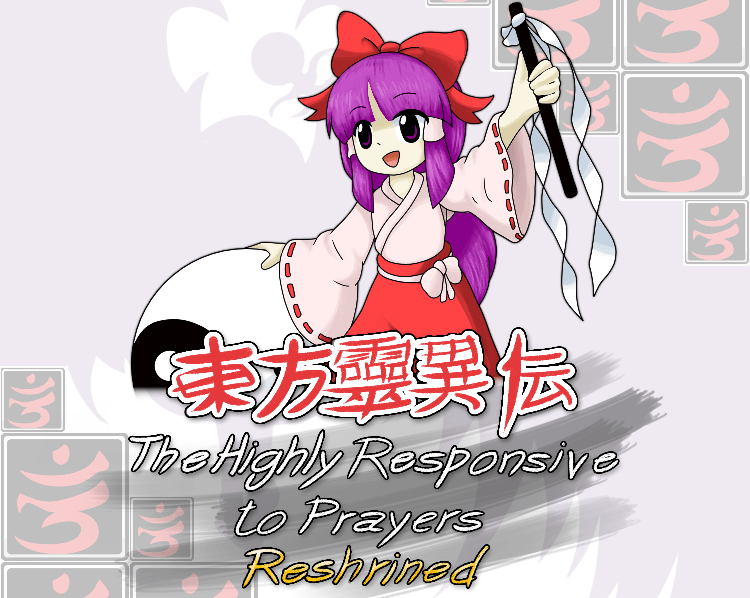
Two months ago, I reviewed the remake of Touhou 6: The Embodiment of Scarlet Devil. And it made you ask: what about the game that launched the franchise? Over the weekend, somebody put out another remake of the very first Touhou Project game, The Highly Responsive to Prayers.
Why did I say ‘another’? Because over six years ago, I released my own remake of the game, albeit in the style of an NES game—you know, Drillimation’s most popular game! Look, back when the NES demake came out, it was literally the only way to play the very first Touhou Project game on Windows without losing your mind trying to configure a crusty old PC-98 emulator. Just like the childhoods for many with Embodiment of Scarlet Devil, the Touhou Project NES Demakes also defined the childhoods of many Generation Alpha players.
But with this new remake by Idunno… I hate to admit it, but this actually might be the definitive version. It’s gorgeous, it plays smoothly, and—what is this? An indie passion project that isn’t completely junk? What dimension am I living in!?
Before I tear into this new game, we need to take a look back at the history of the very first Touhou Project game: how it faded into total obscurity until some internet archeologists dug it up, and how unofficial remakes somehow kept this bizarre shrine-maiden danmaku legacy alive for a whole new generation.
The Original PC-98 Version
The Backstory
Now, before we even look at Idunno’s fancy new remake—or my own trusty NES demake—we have to take a trip back in time. Back to 1996. Or the previous year, depending on whether you ask ZUN when he was finishing up his college side-project in his dorm room.
Back then, Touhou Project wasn’t some multi-billion-dollar global juggernaut dominating anime conventions, plushie shelves, and Spotify playlists. No! If you wanted to play the very first game in the series, The Highly Responsive to Prayers, you couldn’t just hop onto Steam, pull up the Nintendo eShop, or grab a standard floppy disk off a store shelf. You had to physically trek down to Comiket in Tokyo and hunt for a physical copy like some kind of medieval treasure hunter.
And what hardware were you running it on? A standard IBM PC? Heck no. This thing was built exclusively for the PC-98—NEC’s bulky, proprietary Japanese personal computer standard from the ’80s and ’90s that used entirely different architectures, graphics chips, and sound boards just to be difficult! Unless you were living in Japan with a clunky, dust-collecting PC-98 tower sitting on your desk, you were completely out of luck. It was the ultimate ‘Keep Circulating the Tapes’ scenario.
For the longest time, this game was practically a lost myth. Western fans only knew about it through internet archeology, blurry screenshots, and the sheer desperation of trying to make crusty old emulators spit out sound without crashing your entire operating system. ZUN was just a 19-year-old college kid working with Amusement Makers, treating the whole thing as a study project! He had no idea he was about to accidentally father the most prolific indie danmaku franchise on the planet.
So, how does a game born out of a weird Japanese exclusive computer standard actually hold up today? Let’s take a look…
The Core Gameplay
Now, if you go into this expecting a traditional vertical danmaku where Reimu is packing heat and mowing down armies of fairies from top to bottom, think again! Because ZUN hadn’t quite invented modern Touhou yet, The Highly Responsive to Prayers plays less like a standard shooter and more like a twisted, demonic game of Arkanoid!
That’s right—you’re basically playing supernatural Breakout! You control Reimu Hakurei, sliding left and right at the bottom of the screen, using your gohei stick, slide-tackles, and flying amulets to whack a glowing Yin-Yang Orb into a wall of tiles, spirits, and bosses. You aren’t shooting the enemies directly; you’re using a glorified pinball!
And let me tell you, managing that dang orb is a masterclass in frustration. You hit it at the wrong angle, and it bounces right back into your face or drifts aimlessly while a barrage of bullets is raining down from above. Speaking of bullets, enemies and bosses shoot back! How do you cancel their projectiles? By smacking the Yin-Yang Orb into them, or clearing tiles out of the way to trigger screen-wiping chaos.
And if you’re completely cornered and about to lose a life? You hit the bomb button as a last resort. But does it nuke the screen like a standard smart bomb? Of course not! It just flings out a wild burst that might hit a few tiles, but half the time it completely wiffs against bosses, leaving you standing there looking like an absolute idiot while a wall of bullets turns you into paste. Not to mention, the screen flashes so violently that it can cause seizures.
Twenty stages of this stuff, split down the middle after Stage 5 into a choice between the Hell path and the Makai path, each with entirely different stages, weird bosses, and bizarre endings. It’s janky, experimental, and unlike anything else in the entire franchise!
Difficulty
And then we hit the big one: the difficulty. Touhou Project isn’t just known for being a bit challenging—it’s known for taking your lunch money, breaking your fingers, and laughing right in your face. And it all started right here!
Even on Normal mode, The Highly Responsive to Prayers decides to throw out the rulebook and subject you to a grueling, soul-crushing gauntlet. You think you’re just bouncing a little yin-yang ball around like a casual game of Breakout? WRONG! By the time you reach the later stages, the screen turns into an absolute curveball of flashing tiles, swarming spirits, and projectiles flying at you from every dang angle.
The worst part? The game gives you zero room for error with your positioning. One tiny miscalculation on where that orb is bouncing, and it flies past your head while a wall of bullets pins you against the bottom of the screen. You’re frantically trying to slide-tackle, swing your gohei, and dodge incoming fire all at the same time, only to get instantly vaporized. And don’t even get me started on the boss fights! Trying to land consistent hits on a moving target while dodging a danmaku storm makes you want to chuck your PC-98 floppy disk straight out the window. It’s cheap, it’s relentless, and it will test your patience to the absolute breaking point!”
The Characters
Stepping away from the controller-snapping rage for a second, we have to talk about the characters, because this is Touhou before it became an international anime industrial complex. ZUN didn’t just make a weird Breakout clone; he accidentally laid the groundwork for an entire cultural empire featuring an all-female cast of shrine maidens, ghosts, and mythical beasts.
I’ve already talked about this in my Embodiment of Scarlet Devil remake review, but where did this aesthetic even come from!? Back in the day, ZUN took heavy inspiration from arcade classics like Pocky & Rocky for his main shrine maiden vibe, mixed it with some classic 90s manga styling, and somehow created a massive roster of characters in a genre that was usually entirely dominated by grey fighter jets and drab military tanks.
Right at the center, you’ve got your OG duo: Reimu Hakurei and Mima. Reimu is your permanently annoyed, overworked shrine maiden just trying to clean up her smashed-up shrine, sliding around at the bottom of the screen with her gohei stick. And then you’ve got Mima—who isn’t even a regular boss, but a vengeful ghost spirit lurking near the shrine who would go on to become a series staple before disappearing into the shadow realm for decades!
And the rest of the boss lineup? Absolute weirdos! You’ve got Sariel, an angel of death sitting at the end of the Hell path who looks like something straight out of a nightmare, and Shinki-precursors like Elis and Kana Anaberal just hanging out in Makai. Almost none of these characters would ever show up again in later mainline games, making this first roster a bizarre, one-off time capsule of ZUN’s early college fever dreams. It’s obscure and where the legend officially began!
The NES Demake
Backstory
Now, we could sit here and wallow in the sheer impossibility of playing ancient Japanese computer games, but back in 2002, the PC-98 era officially went out of print. Since these games released right as the internet was becoming a thing, dedicated fans started circulating ROMs online and building emulators just to rescue these titles from total oblivion and introduce them to a brand-new generation.
There were plenty of wild ideas thrown around over the years—heck, back in 2015, JynX (and no, I don’t mean the purple Pokémon) dropped an April Fools video teasing a remake of this exact game, but a playable version never actually saw the light of day.
Then we jump to 2016. This whole redemption arc didn’t start over in Tokyo; it started halfway around the world in the United States! Jun’ya Ohta was born in 1977, and nearly a quarter century later in 1999, I was born right here in Buffalo, New York. Living in a border town genuinely feels like living in Gensokyo—the border separating the United States and Canada acting just like the Great Hakurei Barrier separating Gensokyo from the Outside World!
Back then, I was just a high school sophomore dreaming about an NES-style adaptation of the very first Touhou Project game. I didn’t have the programming knowledge to pull it off right then and there, so the project had to wait four years before it finally materialized. And when it finally dropped on January 31, 2020… talk about timing! A global pandemic hit just a few months later, trapping everyone indoors and single-handedly skyrocketing the game into popularity as people looked for anything to keep from losing their minds.
What started as a nostalgic fan project turned into a lifeline for classic shooter fans. But how does my Famicom-style reimagining actually play? Let’s take a look.
Gameplay Differences
Now, when you fire up the Touhou 1: The Highly Responsive to Prayers NES Demake, you might think you’re just getting a straight-up visual downgrade to fit an old-school 8-bit cartridge. But oh no! I didn’t just slap some chunky pixels on a ROM and call it a day—I completely re-engineered how this sucker plays to feel like a legitimate, lost Famicom Disk System classic!
First off, remember how the original game gave you one miserable life bar and zero room for error? Well, the demake actually gives Reimu a proper health bar! Getting hit by a random bullet only chips away a single block, though taking a direct hit from that dang Yin-Yang Orb still chunks off five bars. It’s merciful and civilized! What is this, a game designed for human beings to actually beat!?
And speaking of the Yin-Yang Orb, you aren’t just thrown to the wolves hoping it cooperates. You can actually summon the orb with a simple button press whenever a stage starts or after you bite the dust. But you’ve also got new tools in your arsenal: your trusty amulets are fired with the Z button, while the X button lets you swing your gohei and slide-tackle across the floor like a total breakdancer.
Of course, the changes don’t stop there:
- The Danmaku Evolved: Enemy bullets now fire straight from removed tiles across all difficulties, keeping you constantly on your toes.
- Smart Bombs Reined In: Instead of a screen-wiping nuke that triggers a seizure, your bombs now clear out a specific localized area. You’ve got an unlimited supply, but you have to use ’em strategically!
- Epilepsy Warning Fixed: All those blinding strobe effects from the PC-98 original? Gone! Your retinas will actually survive the experience.
- The Backstory Tweaks: The story gets a nice little Famicom-style twist too, framing the action around the Hakurei Shrine getting absolutely leveled during a massive human-youkai war.
It takes the core jank of the 1997 original and refines it into a tight, responsive, scroll-less action-shooting experience. It’s janky in all the right retro ways, but it plays smoother than butter on a hot skillet!
How the Fans Reacted
So, how did the internet react when Drillimation dropped this masterpiece? Did they praise it like the second coming of Christ? Did they throw a massive block party? Well, let’s just say the web went absolutely bonkers!
If you venture down the YouTube rabbit hole, you’ll find out pretty quickly that Russian gamers love the demake! Seriously, go search ‘touhou nes demake’ on YouTube right now, and you’ll find a few hardcore Russian YouTubers doing full playthroughs, suffering through the exact same boss-fight nightmares as the rest of us.
And across the rest of the web, the reception has been fascinating:
- The Definitive Must-Play: Out of all the games in Drillimation’s library, the Highly Responsive to Prayers demake remains the undisputed fan-favorite. Despite all the technical hurdles and more complex bullet patterns in later entries, players consistently cite this one as an absolute essential classic.
- The Casual Lifesaver: The inclusion of the Chuhou Joutai health system sparked massive debates between hardcore purists and newcomers. Veterans rolled their eyes, but newbies who couldn’t handle the soul-crushing difficulty of the original PC-98 release treated it like an absolute godsend!
- The Polished Port Praise: Even with the hardware limitations of the ancient Famicom, players were genuinely blown away by how smoothly it ran on modern PCs.
Love it or hate it, the fans proved one thing: whether you’re playing on a crusty old PC-98 in a Japanese dorm room or an 8-bit cartridge layout on a modern monitor, Touhou‘s bizarre spiritual roots refuse to die! But many are displeased on how Sariel and Konngara were transformed into a mutation of Asriel Dreemurr from Undertale—the idea for it came from an inside joke I came up with.
The Reshrined Remake
And finally, we’ve arrived at the main event: Idunno’s brand-new fan remake, Touhou 1: The Highly Responsive to Prayers Reshrined! When you see a title claiming to remake the absolute grandfather of the entire franchise, you expect a disaster. You expect half-baked mechanics, broken physics, or a soulless cash-grab. But holy mother of God… this thing is actually, genuinely, unironically incredible!
Right out of the gate, you notice the presentation. It’s gorgeous! It takes the crusty, low-framerate, seizure-inducing visual mess of the 1997 PC-98 original and completely overhauls it with crisp, vibrant sprite work, clean backgrounds, and smooth modern performance. And if you’re a hardcore purist who hates change? The creator actually had the absolute foresight to include a faithful background option for the first five stages so you can still gaze into the pixelated abyss!
And the music? Dragoneex delivered an absolute sonic masterclass with these remixes! Blasting through the Makai and Hell stages with these high-energy, heavy-synth tracks makes you want to pump your fist in the air—even while a boss is turning your health bar into Swiss cheese.
What really makes Reshrined steal the show, though, is how it handles the gameplay. It fixes the archaic jank without losing the core soul of what made the original so unique:
- Local Multiplayer Madness: It adds both co-op and versus modes! Sure, it’s mostly casual, and the balance is a little chaotic, but trying to survive a danmaku screen alongside a buddy is the kind of couch co-op nonsense we’ve been missing for decades.
- Playable Variety: You aren’t just stuck with Reimu anymore. You’ve got a whole roster of characters to unlock—including Mima and Yuuka—each with completely distinct shot types and playstyles that make replaying the game actually fun.
- QoL Sanity Savers: Controller support with actual button remapping! A proper health bar! An item in versus mode to attack your opponent! It feels like a fully realized, modern indie masterpiece built by someone who actually gives a hoot about the source material.
Overall Verdict


Is it better than the PC-98 original? Oh, absolutely. Is it better than my own NES demake? I hate to say it, but it might just be the definitive way to experience the very first Touhou game! However, there are a few setbacks from the demake. For one, the health bar is gone and you’re back to the one-hit deaths of the original. Your lives and bombs are limited again, and you can’t launch the orb wherever you want.
Whether you’re a veteran who spent decades wrestling with emulators or a newcomer who wouldn’t know a PC-98 from a toaster, Reshrined is an absolute triumph. GOTY 2026 material right here. Now if you’ll excuse me, I have to go try and unlock Mima before my fingers completely fall off!
But before I close out this review, we need to talk about reception. Because let’s face it: how a community reacts to these games tells you everything you need to know about where this franchise has been and where it’s going.
The original PC-98 classic—with its weird Arkanoid-meets-danmaku mechanics and its brutal two-route split—pioneered the whole genre, landing comfortably at a solid 8 out of 10. It’s janky, historical, and it made us sweat bullets.
Then came my own NES demake, which most people scored a point higher, sitting pretty at a cozy 9 out of 10. And hey, even when a good chunk of the content is identical to the original, there’s something magical about squeezing an 8-bit miracle onto a Famicom-style layout that people just couldn’t resist!
And for Idunno’s brand-new Touhou 1: The Highly Responsive to Prayers Reshrined remake? Oh, come on—you already know what the score is. It’s an absolute masterpiece and a perfect 10 out of 10.
Whether you’re playing the primitive 1997 original, kicking back with my Famicom demake, or diving headfirst into Reshrined on itch.io, the legacy of Reimu’s very first shrine-clearing adventure lives on. Now if you’ll excuse me, I’m gonna go sink another twenty hours into trying to beat this thing without losing my sanity.
If you’d like to check out the game, I have the link here:
https://greenreimu.itch.io/touhou-1
Discover more from Drillimation Systems
Subscribe to get the latest posts sent to your email.

