

Drawing magical Taoist amulets is a meticulous, ancient art, yet doing so under the frantic pressure of a ticking clock and a hungry zombie companion transforms it into an entirely different beast. Seiga Draws Ofudas is a compact, web-based arcade title that strips away narrative bloat in favor of a focused, tactile gameplay loop. It is a game that relies not on grand scale, but on the simple, satisfying feedback of ink on parchment and the frantic juggling of micro-tasks.
It is a grand and historical tradition in interactive entertainment to take a simple, mundane task, wrap it in a layer of frantic urgency, and call it a video game. Yet, when that task is the ancient and meticulous art of drawing Taoist amulets, and your primary motivation is to prevent a hungry zombie companion from eating your entire inventory, the situation shifts from historical tradition to sheer, unadulterated panic. Developed in just a single week for the Touhou Pride Game Jam 8, Seiga Draws Ofudas is a compact, web-based arcade title that strips away narrative bloat and excessive grandiosity to focus entirely on the tactile, high-stress relationship between a mouse, virtual ink, and a ticking clock.
What to Know
Critic’s Lens
Seiga Draws Ofudas is a wonderfully charming and remarkably polished micro-arcade experience that transforms a simple, repetitive task into a tactile delight. While its game jam constraints mean it is inherently limited in scope and lacks deep progression systems, its tight mechanics, smooth performance, and satisfying sensory feedback make it a highly successful exercise in minimalist design.
Player’s Heart
Players are highly enthusiastic about Seiga Draws Ofudas, calling it an incredibly cute, cozy, and addictive little game. The constant balancing act of drawing amulets, managing ink, and comforting an annoying yet adorable zombie companion keeps the pacing fast and engaging with zero downtime. While some note that the brush sizes don’t always perfectly match the reference shapes, the instant-restart loop and the frantic card-matching finale make chasing high scores and “S” ranks an absolute breeze to repeat.
The Big Picture
Technical and Creative Polish
What is the first thing you expect when you load up a lightweight, 2D browser game made in a single week for a game jam? You expect it to chug. You expect frame drops, screen tearing, and a system running so hot it feels like it’s going to melt right through your desk. But here? Absolutely nothing. Seiga Draws Ofudas runs with a highly stable frame rate throughout the entire experience. There are no stutters when you are drawing, no performance hiccups when you burn your paper, and the transitions between screens are virtually instantaneous. It’s optimized so well it makes you wonder why major, multi-million-dollar studio releases can’t manage the same basic stability.
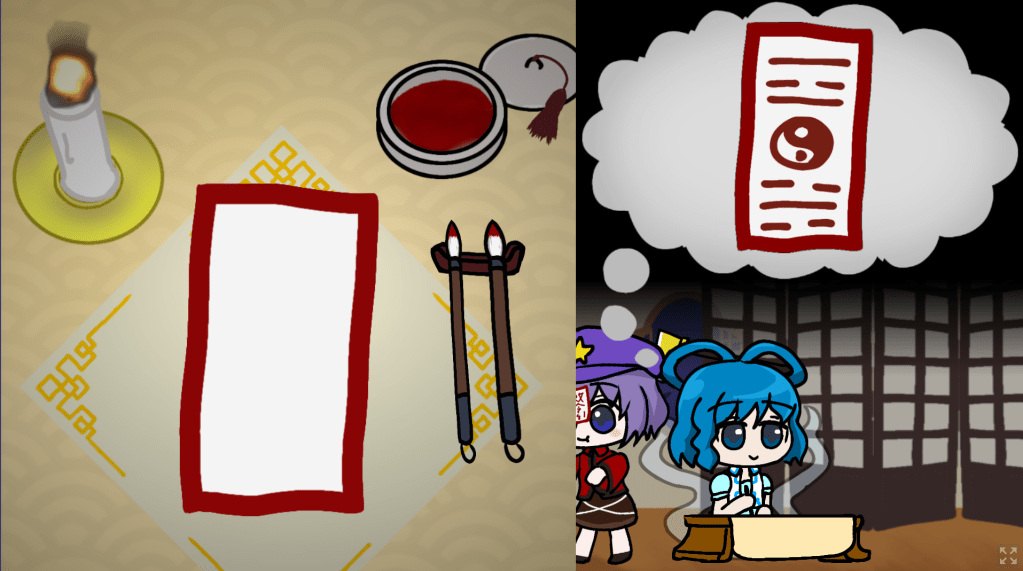
Then we have to talk about the visuals and the layout. Usually, these quick jam games are a mismatched, chaotic mess of pre-made store assets with completely conflicting art styles. But this game features cohesive, hand-drawn 2D chibi art that perfectly fits the Touhou aesthetic. The visual hierarchy is clean and logical. The active drawing scroll, the inkwell, the brush, and the candle are sharply defined, meaning you never have to guess what you can actually interact with. The animations are simple but polished—the ink strokes appear smoothly, the paper curls and shrinks realistically over the flame, and the head-patting sequence has cute, energetic character expressions.
Even the sound design carries a surprising amount of tactile weight. Every stroke of the brush yields a satisfying parchment scratching sound, dipping the brush has a watery sound, and burning your mistakes triggers a sudden fire sound. There is no options menu, no rebindable keys, and no FOV sliders—things that would normally make you scream “what were they thinking?”—but for a simple, mouse-only web game designed to be played in two minutes, those settings are entirely unnecessary. It is a technically sound, visually cohesive package that simply does exactly what it sets out to do without any game-breaking bugs or soft-locks to ruin the experience.
Mechanics
When you first boot up Seiga Draws Ofudas, you are greeted with what seems like a simple task: draw on a piece of paper. But then you actually start playing, and you realize you have to juggle three different things at the same time. What were they thinking? Well, as it turns out, they were thinking of a pretty clever way to keep you on your toes.
The core gameplay loop is divided into three main interactions:
- The Brush and the Ink: You drag your mouse to trace the lines of the ofuda. But you can’t just draw forever; your brush runs dry, requiring you to physically move your cursor over to the inkwell to dip it before you can finish your strokes.
- The Candle: If you make a mistake and your line goes completely off-track, you can’t just undo it. You have to grab the parchment, drag it over to the burning candle, and watch it burn away to start fresh. It forces you to make a split-second decision: do I try to salvage this terrible drawing, or do I burn it and lose precious seconds?
- The Companion: While all of this is happening, Yoshika is standing right there, and her patience is constantly ticking down. If she gets too upset, you have to completely stop what you are doing, move over to her, and pat her on the head to calm her down.
It sounds like a chaotic mess of ideas—drawing, resource management, and a virtual-pet mini-game all shoved into one screen. You’d expect these elements to fight each other for your attention, but they actually flow together seamlessly. The game scales its difficulty perfectly; it starts you off with simple shapes, like hearts, so you can get used to how the brush feels, before throwing complex Kanji characters at you under a shrinking time limit.
Once you manage to survive the drawing phase, the game throws one final curveball at you: a rapid-fire card-matching memory game. The sudden shift from drawing lines to matching cards is a massive change in pace, but the rules are instantly clear. There are no cheap, unearned spikes in difficulty, no artificial grind to pad out the length, and no useless upgrades. Every single mechanic taught to you in the opening interactive checklist is a mandatory, active part of the run. It is a simple, highly focused arcade loop that rewards mechanical precision and quick reflexes, plain and simple.
Sound Design and Music
When you think about a game where you are just drawing on paper, you probably expect the audio to be an afterthought. You expect dead silence, or maybe some generic, royalty-free stock music that makes you want to mute your system after thirty seconds. But here? The audio presentation actually carries the entire experience, and it is handled with a surprising level of care.
Let’s break down the sound design first:
- The Tactile Feedback: Every single stroke of your brush on the parchment has a distinct, physical scratch to it. It doesn’t just feel like you are moving a cursor; it sounds like you are actually scraping ink onto paper.
- The Actions: Dipping your dry brush back into the inkwell makes a clear, watery slosh. Throwing a ruined drawing onto the candle triggers a sudden, realistic flame “swoosh” that lets you know your mistake has been completely incinerated.
- The Interactions: When you stop to pet Yoshika to keep her from throwing a tantrum, the game plays comical, high-pitched squeaks. It sounds incredibly silly, but it fits the lighthearted, cartoonish tone perfectly.
Then there is the soundtrack. Instead of blasting some intense, heavy-metal synth tracks that would feel completely out of place, the background music during the drawing phase is a calm, traditional East Asian instrumental track. It perfectly sets the mood of sitting in a quiet, isolated dojo. But what happens when you finish your drawings and transition into the final memory game? The music doesn’t just violently cut off or loop awkwardly. It transitions smoothly into a fast-paced, high-energy rhythm that matches the sudden panic of the card-matching countdown.
The audio mix is incredibly clean. The music stays at a level where it never drowns out your gameplay cues, meaning you can always hear the distinct “ding” of a successfully completed drawing or the warning cues of Yoshika losing her patience. For a game built in a week, they didn’t just slap some random noise together; they created a cohesive, pleasant, and highly responsive soundscape that does exactly what it needs to do.
Narrative Cohesion
Normally, when you play an arcade game, you expect the story to be a complete afterthought. You expect to be dropped into a world with absolutely zero explanation as to why you are doing what you are doing. But here? The narrative premise is established immediately, and it makes complete sense.
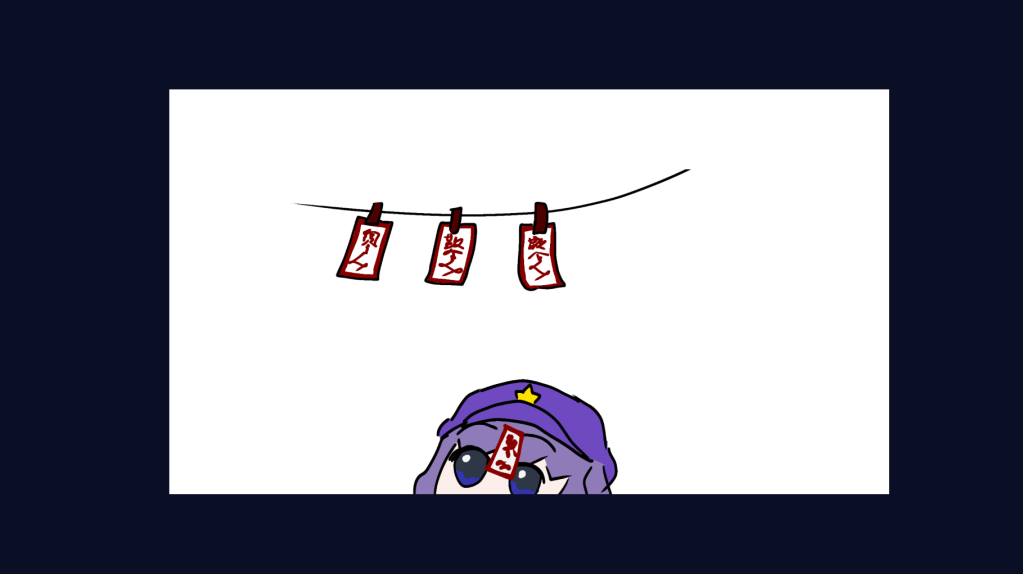
- The Setup: Yoshika has eaten all of the ofuda amulets. That is it. That is the entire plot. It’s simple, it’s stupid, and it perfectly sets up why you are frantically drawing paper talismans on your desk.
- Ludonarrative Integration: A lot of modern games suffer from ludonarrative dissonance—where the story tells you one thing, but the gameplay makes you do something completely different. In this game, there is none of that. The story says Seiga needs to draw replacements to keep Yoshika under control, and the gameplay consists entirely of you drawing those exact replacements while managing her patience. The mechanics are completely aligned with the narrative goal.
- Pacing: There are no massive text dumps, no hours of unskippable cutscenes, and no audio logs you have to stop and listen to just to understand what is going on. You learn everything you need to know from the very first screen, and the game never halts the gameplay to force unnecessary plot points down your throat.
For a game made in a single week, they didn’t try to write a grand, sweeping epic that didn’t fit the scope. They chose a simple, comical premise, aligned the gameplay perfectly with it, and got out of the way. It is consistent, straightforward, and doesn’t break its own rules.
Engagement and Fun
When you sit down to play a game that takes less than five minutes to complete, you expect to get bored fast. You expect to play it once, say “okay, I get it,” and never boot it up again. But Seiga Draws Ofudas manages to grasp your attention within the first ten seconds and completely hold onto it.
How does it keep you so engaged? It comes down to two major factors:
- The Flow State: There is absolutely zero dead air in this game. You aren’t traveling across massive, empty maps, and you aren’t sitting through repetitive, unskippable cutscenes. From the moment you burn the tutorial sheet to start the game, you are constantly active. If you aren’t tracing an ofuda, you are dipping your brush. If you aren’t dipping, you are rushing to pet Yoshika. It keeps your brain constantly occupied, turning a repetitive task into an incredibly addictive loop.
- The Reward Cycle: Because this is an arcade-style game, there is no in-game economy or progression system to unlock. Your reward isn’t a virtual weapon or shiny armor; it’s your final score and rank. Finishing a drawing with high precision gives you a satisfying flash and sound effect, immediately feeding your brain that sweet, sweet dopamine.
You’d think that drawing lines under a strict time limit would start to feel like an actual chore or a day job. But because the game is so responsive and because the visual presentation of Seiga and Yoshika is so charming, the frustration of failing never actually sets in. When you fail a drawing, you don’t feel like the game cheated you. You see exactly where your line went off-track, making you want to immediately click that “Play again” button to prove you can do better. It’s pure, fast-paced arcade engagement that knows exactly how to respect your time.
Replayability
When you have a game that can be beaten in under five minutes, the immediate question is always: “What now?” You expect the game to be a one-and-done experience that you completely forget about the second the credits roll. But Seiga Draws Ofudas takes a page out of the classic arcade playbook to keep you coming back for more.
- The Arcade Mentality: There are no progression systems, no unlockable characters, and no skill trees. If you start a new run, you are playing with the exact same mechanics you used the first time. Normally, this lack of variety would make a game feel completely stagnant. But because the game is built entirely around an arcade-style loop, the draw isn’t about unlocking new gear—it’s about chasing a higher high score and securing that coveted “S” rank.
- The Element of Randomization: The game doesn’t just give you the exact same patterns in the exact same order every single time. The drawing prompts are randomized, and the cards in the final memory-matching phase are completely shuffled every run. This keeps you from simply memorizing the layout, ensuring that you actually have to react and adapt each time you play.
- Zero Downtime: Starting a new run is virtually instantaneous. You don’t have to sit through unskippable opening splash screens, you don’t have to navigate a labyrinth of confusing menus, and you don’t have to replay a tedious, twenty-minute tutorial. The interactive tutorial page can be burned away with your candle in a matter of seconds, putting you right back into the action.
While it is a tiny game jam project that shows you its entire hand in the very first run, it doesn’t try to artificially pad its length with microscopic drop rates, pointless side quests, or paid microtransactions. It relies purely on its satisfying, tactile core gameplay and the breeze of its instant-restart loop to make trying again feel rewarding rather than exhausting.
Learning Curve
There is nothing worse than booting up a brand-new game only to be immediately blasted with page after page of static text explaining thirty different mechanics you don’t care about yet. It makes you want to turn the system off before you even get to move your character. But Seiga Draws Ofudas takes a completely different approach to onboarding. It actually respects your intelligence.
Here is how the learning curve breaks down:
- Interactive Onboarding: Instead of a long, dry slideshow, the tutorial is completely interactive. The starting instructions—explaining how to draw a line, dip your brush in ink, and discard ruined paper with the candle—are printed directly on the very first sheet of paper on your desk. You learn by doing, and you can burn the tutorial page away in seconds to jump straight into the action.
- Pacing the Challenge: The game doesn’t throw you into the deep end right away. It starts you off by prompting you to draw incredibly simple, recognizable shapes. Once you get comfortable with the sensitivity of the brush, the game gradually introduces more complex Kanji characters while shrinking your time limit. It scales naturally, giving you a chance to build muscle memory before things get frantic.
- Clear and Instant Feedback: When you fail, there is zero confusion. You don’t lose because of some invisible collision box or a mechanic the game forgot to tell you about. If a drawing fails, you can visually see exactly where your ink lines deviated from the template. If you run out of time, you can see the red timer bar completely depleted, making it immediately obvious where you need to improve your speed or accuracy on the next run.
It is a remarkably clean, intuitive learning curve. It safe-tests every single mechanic you need in a controlled environment before the real timer starts, and then it expects you to use every single one of those tools to survive. You will never need to consult an external wiki or a strategy guide just to figure out how to play. It teaches you the rules instantly, and then it gets out of the way to let you play.
Feel of Play
When you are playing a game that is entirely interface-driven, you expect the controls to feel like complete garbage. You expect massive input lag between dragging your mouse and seeing the ink on the screen, or you expect the cursor to slide around like it’s on a greased-up baking sheet. If the controls don’t respond instantly, the whole game is ruined. But here? The responsiveness is incredibly sharp.
- Weight and Responsiveness: There is absolutely zero lag when you draw. The very millisecond you drag your left mouse button across the parchment, the ink line appears exactly where you put it. Since there are no platforming physics or character avatars to control, you don’t have to worry about slippery movement or getting stuck on invisible walls. It is entirely snappy and instantaneous.
- Sensory Feedback (“Juice”): Even though the game is played on a static, 2D workspace, it doesn’t feel dead. When you successfully complete an ofuda, the game rewards you with a distinct, satisfying success chime and a quick visual flash before updating your score. The active drawing scroll curls dynamically, the ink visibly depletes from your brush as you draw, and Yoshika reacts with expressive animations to your input.
- Camera and Workspace: A lot of games suffer from terrible cameras that get stuck behind walls or zoom in so close you can’t see what’s hitting you. Here, the camera is completely stationary, keeping the desk, the inkwell, the candle, and the companion perfectly in frame at all times. It completely eliminates any risk of motion sickness or visual confusion, letting you focus entirely on your hand-eye coordination.
It doesn’t try to use gamepad rumble or fancy camera shakes to fake its physical presence. It relies entirely on crisp, localized sound effects and highly responsive mouse tracking to make every single action feel tactile and satisfying. For a game developed in a single week, the physical “feel” of interacting with the board is remarkably polished.
Final Verdict
When you look at a game made in just one week for a game jam, you usually expect to walk away completely disappointed. You expect a broken, unoptimized mess with terrible controls and art that looks like it was thrown together in a blender. But Seiga Draws Ofudas doesn’t do that. It doesn’t try to be a massive, fifty-hour open-world epic, and it doesn’t try to trick you with microtransactions or forced, artificial progression systems.
Instead, it takes a simple, frantic concept—drawing talismans to keep an annoying yet adorable zombie companion happy—and executes it with an incredible level of technical and creative polish. The controls are sharp and responsive, the visual chibi style is highly cohesive, and the tactile sound design actually makes you feel the scratch of the brush on the paper. Aside from a few minor visual quirks where the brush strokes don’t always align perfectly with the reference templates, the game delivers exactly what it promises.
It is a compact, beautifully designed arcade micro-game that respects your time, teaches you its rules instantly, and keeps you coming back to chase that next high score. For what it set out to achieve in a single week, it is a remarkably solid and satisfying package that gives itself a 7.5 out of 10.
If you’d like to try the game for yourself, I have the link here:
https://whaopos.itch.io/seiga-draws-ofudas
Discover more from Drillimation Systems
Subscribe to get the latest posts sent to your email.


Hello
LikeLike
Interesting read.
LikeLiked by 1 person