

Let us step into the hallowed, hand-drawn halls of the Scarlet Devil Mansion, where the noble art of matchmaking meets the frantic, time-sensitive demands of library management. Today, we are looking at Koakuma’s Yuri Collection, a bite-sized submission to the Touhou Pride Game Jam 8 created by StabbyKnives. It is a game that tasks us with a mission of monumental romantic importance: helping the industrious librarian Koakuma navigate her shelves to pair the mansion’s expressive fairy maids with the perfect ‘yuri’ literature to match their unique, discerning tastes. While it carries the unmistakable, raw aesthetic of a weekend jam project—complete with a self-effacing nod from the developer about their art skills and some usage of AI-assisted code—there is an endearing, hectic charm to its frantic matching loop that warrants a closer, more measured inspection.


What to Know
Critic’s Lens
Koakuma’s Yuri Collection overcomes its rough, hand-drawn edges with a wonderfully frantic and cohesive time-management puzzle loop. While its mechanical depth is light and the “trial-and-error” traps can occasionally frustrate, its charming tribute to the Touhou community shines through.
Player’s Heart
Players love the game’s adorable premise and the highly expressive fairy maids, which make memorizing book preferences a joyful, tactile experience. Though the MS Paint-style visuals are simple and a few technical bugs linger, it remains a highly responsive, bite-sized arcade treat that captures the humorous spirit of a classic doujin project.
The Big Picture
Technical and Creative Polish
When analyzing how the game actually runs, the performance remains remarkably stable. The framerate stays locked with no noticeable stuttering or drops, allowing the cursor—rendered as a white hand—to move with pixel-perfect smoothness across the screen. Dragging books from the shelf to the desk and handing them over to characters feels highly responsive and seamless. The sliding curtain transitions, book reveals, and UI changes render consistently without frame-pacing hitches, largely because the lightweight 2D assets demand very little from the hardware.
However, there is a specific menu bug to note: if you are playing the online web version and click “Exit” on the main menu, the game freezes instantly. Beyond this menu freeze, there are no game-breaking progression blockers.
A notable point of potential confusion occurs when interacting with Patchouli. If you attempt to hand her a second book while she is already holding one, she will repeatedly say, “I’m still working on the other one. Bring that back first,” and refuse to accept any more books. While this might initially look like a soft-lock, it is actually a gameplay mechanic: you must left-click the book already sitting on her desk to read her synopsis before you can hand her a new one. Once clicked, her dialogue advances, the desk clears, and normal progression resumes.
Additionally, the transition at the end of a round is clean, moving smoothly to the score tally screen and returning you safely to the main menu.
Loading screens are practically nonexistent. Moving from the title screen to the opening dialogue, or transitioning straight into the bookshelf gameplay, happens instantly. There are no loading bars or artificial delays.
As a web browser game hosted on itch.io with a tiny Windows download size of only 33 MB, it is highly optimized for its target platforms. It runs exceptionally light, using flat 2D sprites and simple text boxes instead of taxing GPU-heavy elements, so you can easily tab between the game and other applications without system lag.
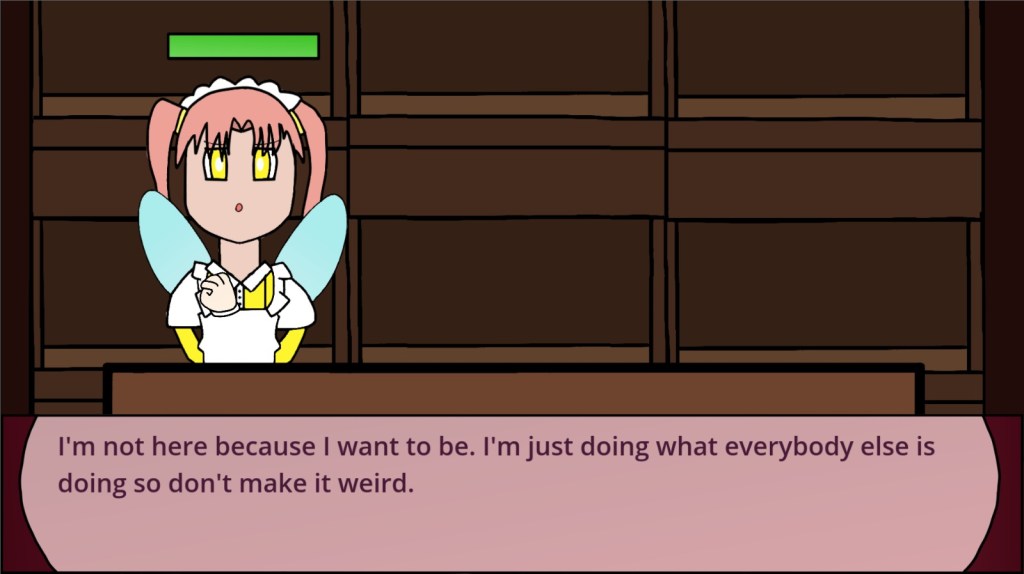
The interface is designed with a direct, functional approach. The main menu is stripped down to just three large, clearly separated buttons: Play, Tutorial, and Exit. During active gameplay, the screen is split cleanly between the shelves on one side and the active counter desk on the other. There is no HUD clutter; the only real-time indicators are the simple patience bars floating above the fairies’ heads.
Hovering over a book instantly triggers a white border highlight and shifts the cursor from an open glove to a clenched fist when grabbed, providing clear visual feedback.
Navigation is remarkably direct. Selecting Play instantly launches the game without secondary profile selection screens or nested options. Dialogues are advanced cleanly with simple spacebar presses.
However, because this is a short, free project made for Touhou Pride Game Jam 8, the game completely lacks a settings panel. Aside from a basic mute/unmute audio toggle in the corner, there are no options to rebind the static controls, scale the subtitles, toggle colorblind filters, or adjust the hand-drawn dialogue font. This lack of basic quality-of-life options may present accessibility hurdles for players with visual or reading impairments.
Mechanics
At its heart, the game is a condensed, rapid-fire time-management puzzle that operates in short, frantic bursts. Rather than drawing out the experience with progression systems, virtual currencies, or artificial grinding, a single run is tightly capped to roughly two minutes.
The central loop is highly reminiscent of classic arcade management titles:
- Assess the Request: A customer fairy arrives at the counter and displays a text prompt reflecting her romantic book preferences.
- Retrieve the Matching Volume: You must quickly scan the bookshelves, find a book that aligns with her unique taste, and drag it over to her desk.
- Beat the Clock: Each customer has a visible, slowly draining patience bar floating above her head. You must satisfy their request before this bar empties.
While the fundamental task is simple, the game’s difficulty relies entirely on multitasking and speed. As the timer counts down, the fairies’ patience drains faster and they arrive in greater numbers, forcing you to organize and process requests with increasing rapidity. Because there are no unlockable tools, branching paths, or character upgrades, the longevity of the game relies almost entirely on players chasing high scores on the final results screen.
The control scheme is highly intuitive, completely mouse-driven, and relaxed enough to be played comfortably with a single hand:
- Left-Click: Used to grab a book, drag it across the screen, or interact with menu elements.
- Right-Click: Instantly flips over and reveals the cover of whatever book you are currently holding.
- Spacebar / Enter: Quickly advances or skips the dialogue screens.
- Escape: Pauses the action or exits the game.
Because the game utilizes a static 2D grid-based interface rather than a dynamic physics engine, there is no physical momentum, slippery inertia, or weight to grapple with. When you drag a book and let go, it instantly snaps cleanly into the nearest designated slot on the shelf or counter. Books cannot bounce, fall over, or slide awkwardly, and selection detection is exceptionally precise—hovering over any interactive object instantly highlights it with a crisp white border to ensure you never misclick.
While the baseline rules are highly consistent, the game introduces a few specific hurdles that shift the difficulty:
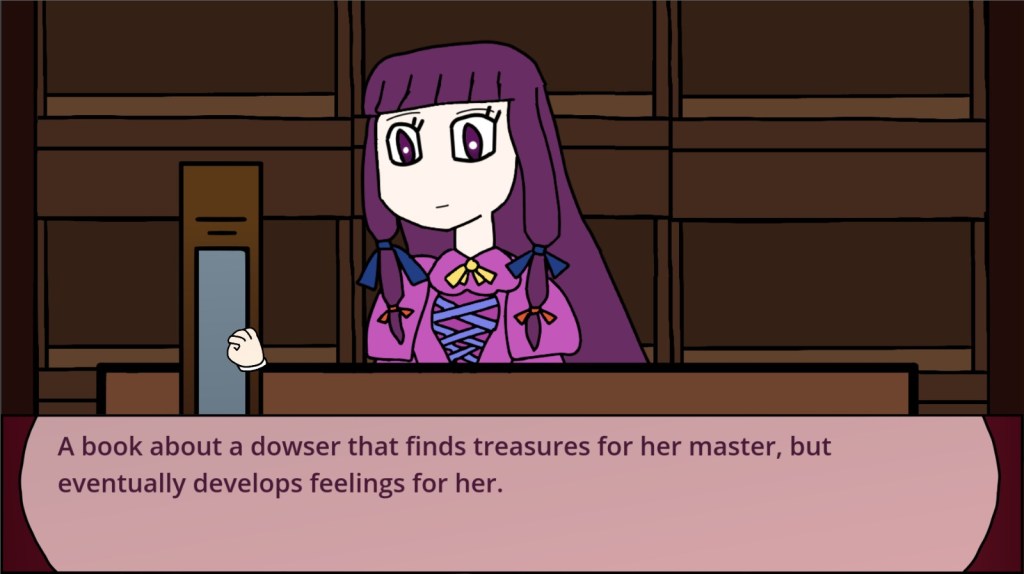
- The Help Mechanic (Patchouli): If you are unsure what a book is about, you can place it on Patchouli’s desk to receive a written synopsis. However, this acts as a double-edged sword: Patchouli will only read one book at a time. If you try to hand her another, she blocks you by repeating, “I’m still working on the other one. Bring that back first,” forcing you to click her active book to clear it before you can proceed. This mechanical friction adds a layer of strategic risk, as consulting her drains valuable seconds from your timer.
- The “Trial-and-Error” Traps: Hidden among the normal volumes are “Magical Books”. While sitting on the shelf, these traps are visually identical to normal books. Picking one up instantly triggers a full-screen flash and a harsh buzzer sound, temporarily paralyzing your cursor. Because there is no visual indicator to distinguish them beforehand, avoiding these traps requires you to either painstakingly cross-reference them with Patchouli (which slows you down) or simply memorize their locations through frustrating trial-and-error. Under a strict time limit, hitting one of these traps can instantly compromise a high-scoring run.
The space is entirely self-contained. The game takes place on a single, fixed 2D screen, rendering camera management completely non-applicable. There are no panning, zooming, or tracking issues, and the entire playing field—including the fairies, the books, and the patience bars—is perfectly visible at all times.
In terms of systems cohesion, the mechanics are exceptionally focused. The game does not try to shoehorn unnecessary crafting, survival, or combat mechanics into its loop. Every element—from reading customer preferences and checking book covers to managing the strict patience meters—works in absolute harmony to deliver a classic, logically consistent arcade matching experience.
Sound Design and Music
For a casual, time-management puzzle game, the sound effects are mixed prominently and provide vital, real-time tactical feedback. Every critical action in the library triggers a corresponding audio cue:
- Menu and Navigation: Clicking on options or advancing the scrolling text boxes triggers a light, gentle typing chime.
- Tactile Feedback: Grabbing a book and dragging it across the shelves triggers a distinct, mechanical paper-rustling sound effect.
- Success Cues: Handing a correct volume to a waiting fairy immediately triggers a bright, highly satisfying “ding”.
- Failure and Trap Cues: Accidentally grabbing a disguised “Magical Book” triggers a harsh, loud explosion and buzzer sound, serving as an instant auditory warning that your cursor is paralyzed.
However, because the game does not utilize dynamic pitch or volume randomization, these static audio assets can become highly repetitive. Hearing the exact same high-pitched “ding” or paper slide dozens of times in a single two-minute round can quickly lead to minor audio fatigue.
Additionally, because the game operates strictly on a flat, static 2D screen, spatial or directional audio is entirely inapplicable. The sound effects are mixed in standard stereo, and you do not need directional cues to understand where a fairy is or when a timer is running low, as all threats are visually front-and-center. There are also no issues with audio clipping or sounds cutting off abruptly, as effects simply trigger at a set volume and fade out naturally.
The background music consists of a single, lighthearted, and upbeat chiptune instrumental track. The bouncy, energetic tone matches the frantic, comedic pacing of the book-matching gameplay perfectly. Since the narrative maintains a playful, low-stakes vibe from start to finish, there are no dramatic or somber moments where the upbeat music feels out of place.
The musical loop itself is relatively short. While this would normally make the soundtrack grating over long play sessions, it is largely mitigated by the game’s bite-sized structure. Because a single run lasts only about two minutes before transitioning to a short, comedic failure ditty on the results screen, you are never exposed to the music loop long enough for it to wear out its welcome.
In terms of mixing, the default levels are well-balanced. The upbeat music is mixed at a slightly lower, softer volume, allowing the loud, sharp gameplay sound effects—such as the paper rustling and warning buzzers—to easily cut through the track. Even though the game lacks individual volume sliders and only features a basic master mute toggle in the bottom-left corner, you will never struggle to hear important mechanical cues over the soundtrack.
Narrative Cohesion
A common issue in gaming is ludonarrative dissonance—where what you are doing in the gameplay conflicts directly with what the story is telling you. Thankfully, this title avoids that trap completely.
The narrative setup is simple: Koakuma wants to transform the Scarlet Devil Mansion’s library into a welcoming “Library of Love” by matching the local fairy maids with their ideal romantic ‘yuri’ books. The gameplay mirrors this premise perfectly. You are not fighting enemies or saving the universe; your entire mechanical input consists of reading these fairies’ personal tastes and physically retrieving the book that satisfies them. Every puzzle solved directly forwards Koakuma’s narrative goal of making her visitors happy.
Additionally, the pressure of the gameplay is justified by the narrative. The ticking on-screen timer represents the frantic nature of managing a busy library shift. There are no open-world distractions, side quests, or out-of-place mini-games to derail the urgency of the premise.
Because this is a game jam project developed in a weekend, the world-building is naturally minimal, relying heavily on the player’s pre-existing familiarity with the Touhou Project universe.
However, the game uses its limited assets effectively to establish its setting:
- The Library Setting: The background features towering, dark wooden bookshelves that immediately establish the grand, slightly imposing atmosphere of the Scarlet Devil Mansion’s library.
- Character Integration: The characters behave exactly as fans of the franchise would expect. Patchouli Knowledge—the mansion’s resident intellectual—sits at her desk acting as your source of information, reading book synopses for you but getting easily annoyed if you try to overwhelm her with multiple books at once.
- The Fairy Maids: The fairy maids exhibit highly expressive reactions that tell a story in their own right. Successfully delivering a book rewards you with warm smiles, while failure triggers comical, exaggerated cartoon tears.
While there are no hidden lore documents or complex environmental puzzles, the clean visual layering and character behaviors successfully sell the premise of a chaotic, cozy day in the mansion’s library.
Engagement and Fun
On a fundamental level, the engagement of the game relies entirely on a classic, well-tested psychological trigger: the thrill of managing mounting chaos under a ticking clock. Because a single session is capped at a strict two-minute limit, the game completely bypasses the slow, methodical pacing of larger puzzle games and drops you straight into the deep end.
The fun is found in the frantic rhythm of the “triage” loop:
- Active Memorization: You are forced to quickly memorize the unique, romantic preferences of incoming fairy maids.
- Pattern Recognition: You must visually sort through the rows of book spines on the shelves, matching their titles or colors to the correct fairy on the fly.
- The Risk/Reward of Consultation: Choosing whether to waste valuable seconds letting Patchouli read a book’s synopsis—risking a hit to your customer’s patience meter—or blindly guessing the book’s contents to save time.
This constant, rapid risk assessment makes the simple act of dragging and dropping books feel surprisingly high-stakes.
For a simple game jam project with minimal mechanics, much of the fun is carried by its sheer charm. The game excels at making your performance feel immediately impactful. Successfully matching a book rewards you with a satisfying “ding” and a warm, grateful smile from a fairy maid.
Conversely, failing is treated with a lighthearted, comedic touch. Delivering the wrong book or letting the timer run out triggers dramatic, giant cartoon tears and a blunt results screen declaring, “You did a TERRIBLE job.” This self-aware, playful presentation prevents failure from feeling overly punitive or frustrating. Instead, it encourages you to immediately dust yourself off and jump back in for another quick, lighthearted round.
Replayability
When assessing how much longevity is packed into this 33 MB package, the reality of its game jam origins becomes clear. While the initial two-minute rush of organizing books is highly engaging, the game offers a completely static experience. The bookshelf layout, the locations of the disguised “Magical Book” traps, and the book titles themselves do not change or randomize between runs.
Once you have completed a couple of sessions, you will likely have memorized:
- The exact locations of the paralyzing trap books.
- Which book titles correspond to which fairy’s specific tastes.
This lack of procedural generation or layout randomization means that the tactical puzzle element eventually gives way to pure muscle memory.
Because there are no unlockables, alternative gameplay modes, secret characters, or branching story paths, your motivation to click “Play” again rests entirely on self-improvement. The replay value is driven solely by your desire to beat your previous high score on the final results screen.
While there is a brief technical hiccup on the web version where playing multiple times in a row without reloading can occasionally trigger a black screen instead of the results menu, the game’s local Windows download remains a stable, quick distraction. It functions perfectly as a short, arcade-style micro-game that you load up for five to ten minutes of quick, high-speed coordination practice, but it is not designed to hold your attention for hours on end.
Learning Curve
When analyzing how quickly a player can get a grip on the core gameplay loop, the game presents a remarkably gentle entry point. Because it is a bite-sized project made for Touhou Pride Game Jam 8, it doesn’t burden the player with complex manuals or nested tutorial screens. The basic rules are explained step-by-step through a brief, mandatory introductory dialogue that can be breezed through with simple spacebar presses.
Within the first minute of your very first run, you will fully grasp what is expected of you:
- Read a fairy’s book preference from her text bubble.
- Scan the shelves, grab a matching book with a left-click, and deliver it to her desk before her patience bar drains.
- Avoid the hidden “Magical Book” traps that temporarily paralyze your cursor.
The learning curve for the basic mechanics is practically flat, allowing players of any skill level to immediately understand how to play without hitting a wall of mechanical confusion.
However, while the physical mechanics are learned instantly, the actual mastery of the game introduces a steep, brief curve centered entirely around pattern recognition and memorization. The game does not highlight which books match which fairies on the shelf; instead, you must either waste valuable seconds placing volumes on Patchouli’s desk to read her written synopses or begin memorizing the titles and spine colors yourself.
As a result, your first run is almost guaranteed to feel incredibly chaotic and result in a comedic failure screen. The true “learning” happens over your next three to four attempts, as you naturally begin to associate specific book titles with the corresponding fairy maids’ personalities. Once you bypass this brief trial-and-error memory phase, the challenge shifts entirely from learning what to do to executing those actions as quickly and flawlessly as possible under a tight, two-minute clock.
Feel of Play
When translating the mechanical loop into physical sensation, the overall feel of the game is characterized by a frantic, high-speed kinetic energy. Because you are constantly racing against a rapidly draining clock, playing the game feels less like a slow, intellectual puzzle and more like a high-speed reaction test. There is a palpable sense of tension as you try to coordinate your eyes and your hand:
- The Scan: Rapidly sweeping your eyes across the bookshelves to pick out specific color spines or text titles.
- The Grab: A satisfyingly tactile click-and-drag motion that snaps books cleanly to your mouse cursor with zero input lag.
- The Drop: Swooping across the screen to deposit the volume onto a desk and instantly returning to the shelves to start the process over again.
This tight, rhythmic cycle of “grab, identify, deliver” establishes a highly engaging flow state. For the duration of the two-minute round, your hand is in constant motion, making the gameplay feel incredibly active, snappy, and physically responsive.
The sensory landscape of the library creates a sharp contrast between success and failure that heavily influences the player’s emotional state. When you are performing well, the game feels incredibly rewarding. Delivering the correct book triggers a bright, satisfying “ding” chime and a warm, smiling sprite reaction from a fairy maid, providing a quick hit of visual and auditory positive reinforcement.
However, this smooth flow is constantly threatened by a lingering sense of dread. Knowing that a single, visually disguised “Magical Book” trap could be sitting on the shelf creates a layer of hesitation. When you do accidentally trigger a trap, the sudden, jarring buzzer sound and full-screen color flash act as a harsh, disruptive spike to your momentum. This sensory interruption—combined with the temporary paralysis of your cursor while the timer continues to tick down—makes hitting a trap feel genuinely punishing, heightening the frantic, desperate scramble of the game’s final seconds.
Final Verdict
On one hand, you’ve got a game that actually functions. The cursor moves smoothly, the menus work, and the paper-rustling sound effects are incredibly snappy. It runs in a browser without instantly melting your computer, which is more than I can say for some of the absolute garbage we’ve played on the NES or Sega CD. The simple, MS Paint-style artwork even has a weird, charming, self-aware indie vibe to it.
But then you look at the other side of the coin. There is absolutely no depth here. You figure out the entire game in the first sixty seconds. A single round lasts two minutes, and then… that’s it. You’re just chasing a high score. And don’t get me started on the “Magical Book” traps. They look exactly like normal books on the shelf, but if you touch one—bam—screen flash, loud buzzer, and your cursor is completely paralyzed while the timer keeps ticking. It’s pure trial-and-error design. Why do games do this? It doesn’t make it challenging; it just makes you hesitate.
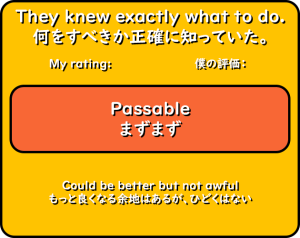
So, what’s the final score? It’s a passable 6.5 out of 10.
It’s not a masterpiece, but it’s certainly not a total load of garbage either. It’s a functional, bite-sized game jam project that does exactly what it set out to do, even if it leaves you wishing there was a whole lot more to it.
If you’d like to try the game, I have the link here:
https://stabbyknives.itch.io/koakumas-yuri-collection
Discover more from Drillimation Systems
Subscribe to get the latest posts sent to your email.

