
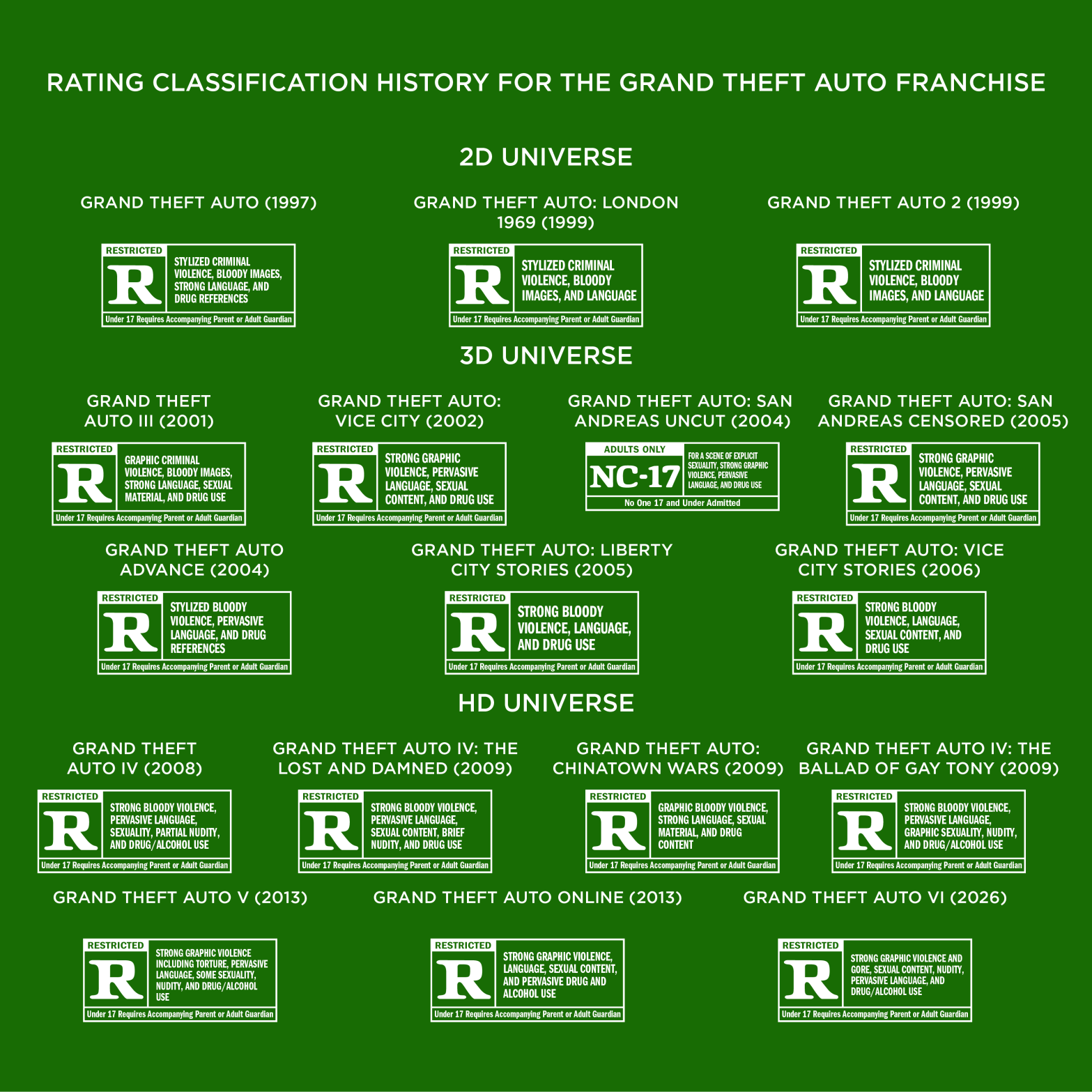
Following the historic global launch of Rockstar Games’ Grand Theft Auto VI on Thursday, we want to talk about a comprehensive retrospective examining how the Grand Theft Auto franchise has repeatedly tested, defined, and pushed the boundaries of the R rating (Restricted – Under 17 Requires Accompanying Parent or Adult Guardian) across nearly three decades.
Since the series’ top-down debut in 1997, every single mainline installment, expansion pack, and handheld spinoff in the Grand Theft Auto catalog has received an R classification—with one notable historical brush with the NC-17 threshold in 2005.
Complete Rating Archive
The 2D Universe (1997-2001)
| Year | Title | Rating |
|---|---|---|
| 1997 | Grand Theft Auto | Rated R for stylized criminal violence, bloody images, strong language, and drug references. |
| 1999 | Grand Theft Auto: London 1969 | Rated R for stylized criminal violence, bloody images, and language. |
| 1999 | Grand Theft Auto 2 | Rated R for stylized criminal violence, bloody images, and language. |
The 3D Universe (2001-2008)
| Year | Title | Rating |
|---|---|---|
| 2001 | Grand Theft Auto III | Rated R for graphic criminal violence, bloody images, strong language, sexual material, and drug use. |
| 2002 | Grand Theft Auto: Vice City | Rated R for strong graphic violence, pervasive language, sexual content, and drug use. |
| 2004 | Grand Theft Auto: San Andreas (uncut version) | Rated NC-17 for a scene of explicit sexuality, strong graphic violence, pervasive language, and drug use. (Note: Was originally rated R, reclassified NC-17 in 2005 due to a locked, explicit sexual minigame before being restored to R upon removal of the files.) |
| 2004 | Grand Theft Auto: San Andreas (censored version) | Rated R for strong graphic violence, pervasive language, sexual content, and drug use. |
| 2004 | Grand Theft Auto Advance | Rated R for stylized bloody violence, strong language, and drug references. |
| 2005 | Grand Theft Auto: Liberty City Stories | Rated R for strong bloody violence, language, and drug use. |
| 2006 | Grand Theft Auto: Vice City Stories | Rated R for strong bloody violence, language, sexual content, and drug use. |
The HD Universe (2008-present)
| Year | Title | Rating |
|---|---|---|
| 2008 | Grand Theft Auto IV | Rated R for strong bloody violence, pervasive language, sexuality, partial nudity, and drug/alcohol use. |
| 2009 | Grand Theft Auto IV: The Lost and Damned | Rated R for strong bloody violence, pervasive language, sexual content, brief nudity, and drug use. |
| 2009 | Grand Theft Auto: Chinatown Wars | Rated R for graphic bloody violence, strong language, sexual material, and drug content. |
| 2009 | Grand Theft Auto IV: The Ballad of Gay Tony | Rated R for strong bloody violence, pervasive language, graphic sexuality, nudity, and drug/alcohol use. |
| 2013 | Grand Theft Auto V | Rated R for strong graphic violence including torture, pervasive language, some sexuality/nudity, and drug/alcohol use. |
| 2013 | Grand Theft Auto Online | Rated R for strong graphic violence, language, sexual content, and pervasive drug/alcohol use (Unrated online interactions and in-game purchases) |
| 2026 | Grand Theft Auto VI | Rated R for strong graphic violence and gore, sexual content, nudity, pervasive language, and drug/alcohol use. |
Why Do All of Them Have “R” Classifications?
An R rating (Restricted – Under 17 Requires Accompanying Parent or Adult Guardian) signals to parents and consumers that a work contains adult material—such as intense or persistent violence, pervasive strong language, explicit sexual content, nudity, or drug use—that is generally unsuitable for minors. Across every era of the Grand Theft Auto series, from its stylized 2D origins in 1997 to the photorealistic fidelity of the HD Universe, the franchise has consistently combined these mature thematic pillars:
- Persistent Criminal Violence and Realism: While early installments like Grand Theft Auto (1997) and Grand Theft Auto 2 (1999) relied on stylized, top-down depictions of bloody criminal violence, the transition to 3D and HD environments introduced graphic, realistic violence, ballistic trauma, and mature themes—such as the torture sequences in Grand Theft Auto V (2013) and the near-cinematic realism of Grand Theft Auto VI (2026)—that exceed the boundaries of lower rating tiers.
- Pervasive Vulgar Language and Substance Use: Nearly every mainline installment, expansion pack, and handheld spinoff incorporates frequent strong profanity alongside depictions of illegal drug and alcohol use, elements that the guidelines explicitly reserve for Restricted classifications when presented persistently or realistically.
- Explicit Adult Environments and Sexual Content: Beginning with Grand Theft Auto III (2001) and Vice City (2002), and expanding through Grand Theft Auto IV (2008) and Grand Theft Auto VI, Rockstar Games has depicted adult nightlife, nudity, and sexual themes that require parental restriction without crossing into purely pornographic territory.
How to Navigate R and NC-17 Thresholds
Rating systems are designed to reflect the consensus of American parents regarding age-appropriate content while preserving creative expression within clearly defined boundaries. Throughout its history, Rockstar Games has repeatedly tested the upper ceiling of the R tier—not only within Grand Theft Auto, but across dark, mature titles such as Manhunt (2003) and Manhunt 2 (2007).
When a submission crosses from mature storytelling into overly explicit, unsimulated sexual mechanics or extreme aberrational content—as occurred with the locked sexual minigame files discovered in the original 2004 release of Grand Theft Auto: San Andreas (reclassified in 2005) or the uncut edition of Manhunt 2—the work exceeds R-tier parameters and receives an NC-17 (No One 17 and Under Admitted) or equivalent adult-only classification. By removing or modifying those specific elements, creators bring the work back within the R standard, ensuring it remains accessible through mainstream retail channels that enforce strict age verification.
Ultimately, the consistent assignment of R classifications across the Grand Theft Auto catalog reflects Rockstar Games’ deliberate commitment to satirical, uncompromising crime drama aimed strictly at adult audiences, paired with rigorous adherence to the upper limits of mainstream content standards.
Evaluation Note for Grand Theft Auto VI
In assigning an R classification to Grand Theft Auto VI, board members noted that the title represents the highest degree of photorealistic adult content ever submitted under the R tier.
With Grand Theft Auto VI, Rockstar Games pushes right up against the upper ceiling of the R rating without crossing into NC-17. Players experience hyper-realistic ballistic trauma, explicit adult nightlife environments, pervasive profanity, and mature criminal themes rendered at near-cinematic fidelity. All physical and digital storefronts continue to strictly verify customer age upon purchase.
Discover more from Drillimation Systems
Subscribe to get the latest posts sent to your email.


An interesting and comprehensive look at one of the most controversial and influential video game franchises in history!
What makes Grand Theft Auto particularly fascinating is how it has evolved alongside technology, society, and changing attitudes towards violence and adult entertainment. From its simple 2D beginnings in 1997 to today’s highly realistic gaming environments, the franchise has continually challenged the boundaries of creative freedom and parental responsibility.
LikeLike