

It is time once again to talk about video games—specifically, a little title known as AliceWare, developed by a team for the Touhou Pride Game Jam 8, some of which worked on previous games that I’ve reviewed including Tewi Jumps Off a Mountain and Dies and Touhou Beastly Territorial Game.
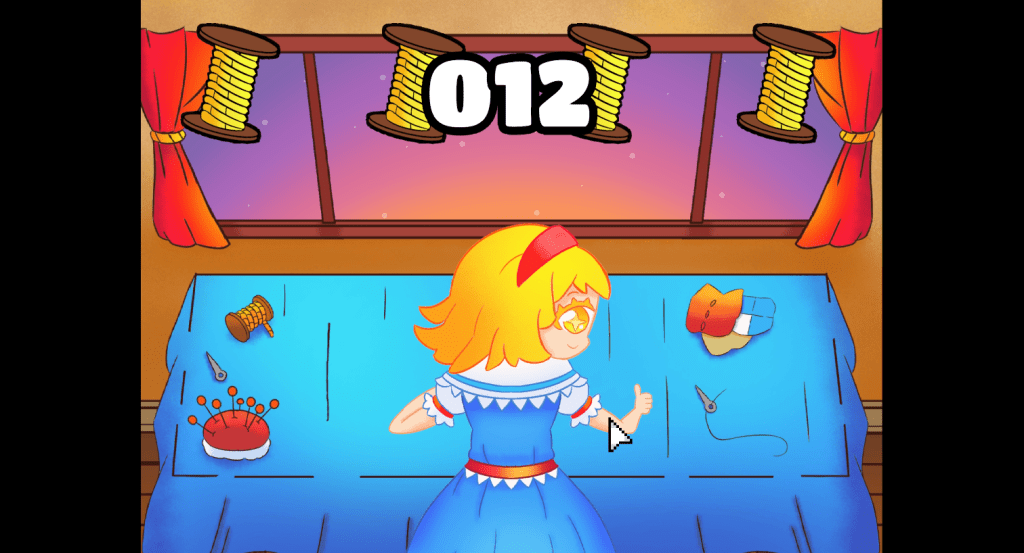
Now, if you are familiar with the WarioWare archetype, you already know the underlying blueprint. You are thrown into a rapid-fire gauntlet of fleeting microgames, given milliseconds to comprehend a prompt, and forced to execute twitch-reflex inputs before the timer expires. In the case of AliceWare, this microgame marathon is wrapped in a lighthearted, comedic narrative: Tewi has ruined Alice Margatroid’s Valentine’s Day gift, leaving Alice with a single night to craft a replacement before Marisa Kirisame arrives.
Across its run, the game cycles through ten distinct microgames spanning a surprising range of genres—stretching from needle-threading, plush-decorating, and potion-brewing to bullet-hell dodging, fishing, and even a low-poly first-person shooter segment. The tempo steadily accelerates as you clear rounds, ultimately culminating in a boss battle against Fumo Reimu. With infinite continues built in to keep the experience accessible, AliceWare presents an energetic, arcade-style test of reaction times, visual clarity, and fast-paced mechanics.


What to Know
Critic’s Lens
Fast, charming, and unapologetically frantic, AliceWare delivers a delightfully quirky homage to the WarioWare formula. While its brief runtime and technical hiccups leave it feeling like a fleeting arcade teaser, its crisp visual variety and snappy mechanics make it a memorable jam entry.
Player’s Heart
Players love the frantic tempo, energetic soundtrack, and creative microgame variety—especially the standout boss fight against Fumo Reimu. Though a few trickier microgames and missing QoL settings cause occasional frustration, the endless continues keep the fun rolling.
The Big Picture
Technical and Creative Polish
What’s up, guys? Now, when you pop open the hood of AliceWare, you’re looking at a pretty solid piece of code from a purely functional standpoint. The framerate stays smooth and stable across the board, with zero noticeable stuttering or dramatic drops in performance during microgame transitions. You won’t run into any game-breaking bugs, crashes, soft-locks, or progression blockers while playing. On top of that, load times are practically non-existent—transitions between the main table, the curtain overlays, and the individual microgames trigger instantly without keeping you sitting around waiting. It also doesn’t cause any abnormal hardware heat spikes or hardware strain.
The user interface keeps things minimalist and clean. Objective prompts, timer visuals, and life counts are positioned cleanly on screen, and navigating through the menus is straightforward with direct single clicks. Now, where you do hit a bit of a snag is in the options menu. It gives you standard volume sliders for master, music, and sound effects, but it completely lacks key QoL features like rebindable controls or graphic configurations. Furthermore, if you’re playing the web/HTML5 version, it doesn’t support a confined cursor mode, which means your mouse can easily drift right out of the game window unless you run it in full-screen.
Visually, the game jumps all over the place—from 2D hand-drawn art and pixel graphics to a low-poly 3D retro perspective. While that kind of visual shift might seem erratic at first glance, it’s a deliberate artistic choice styled after the fast-swapping WarioWare format. The visual hierarchy is sharp, making interactive targets, hazards, and background layers easily distinguishable from one another. Animations are snappy, and the audio-visual feedback hits hard with distinct button clicks, success chimes, explosions, and visual popouts.
Mechanics
Now, from a purely mechanical stance, AliceWare delivers exactly what you’d expect from a bite-sized arcade reflex test. You aren’t going to find deep character customization, skill trees, or complex RPG loadouts here—by design, the core gameplay loop relies entirely on rapid mental adaptation and immediate execution.
Each microgame presents a singular task—such as clicking targets, pattern matching, pressing directional keys, or managing simple timing windows—before the countdown timer runs out. The challenge doesn’t stem from mastering intricate systems, but rather from maintaining composure as the cycling speed ramps up sharply with each passing round.
The control schemes across the microgames rely on simple, responsive inputs like mouse clicks, spacebar hits, or basic movement keys. However, there are a few control quirks to be aware of:
- Layout Restrictions: Certain segments—most notably the final boss fight—rely on directional arrow keys without built-in options to remap controls. This can create an awkward layout constraint for players on non-standard setups, such as French AZERTY keyboards.
- Trial-and-Error Prompts: While most microgame goals are instantly intuitive, certain rounds (like the “dream” microgame) can feel unclear on your first attempt, forcing brief trial-and-error moments under tight time pressure.
Despite these minor hurdles, the game maintains a fair mechanical foundation. Collision detection remains reliable across varying mini-tasks, camera perspectives are cleanly locked to each stage, and failure states result strictly from missing required prompts rather than inconsistent physics.
Sound Design and Music
From an audio perspective, AliceWare relies on punchy, cartoonish, and energetic sound design to complement its rapid pacing. Key actions—such as needle threading, scissors cutting, gunshots, and explosions—are paired with distinct audio cues that clearly register when an objective is completed or failed.
Here is a quick overview of how the sound design and music function across the game:
- Audio Feedback: Core interactions utilize crisp, exaggerated sound effects—ranging from sharp clicks to heavy explosion pops—that give instant feedback during short microgame windows.
- Game Over Audio: The glass-shattering sound effect played upon losing a run serves as a distinct audio marker, though it was noted by some players as slightly jarring during repeated game-overs before being adjusted in post-jam updates.
- Music and Pacing: The soundtrack remains upbeat, energetic, and arcade-focused throughout. Because individual microgame runs are short and transition quickly, the soundtrack maintains momentum without feeling overly repetitive.
- Gameplay Cues: Important audio indicators, such as countdown ticks and success or failure chimes, are mixed clearly above the background tracks so players can track time without looking away from the action.
- Voice Acting and Text: The game omits full voice acting, relying instead on text boxes and simple UI sound effects to communicate dialogue and narrative prompts.
Narrative Cohesion
From a storytelling perspective, AliceWare maintains a direct and intentional connection between its narrative setup and core gameplay structure. The game uses a lighthearted, comedic premise—remaking a destroyed Valentine’s Day gift overnight before Marisa Kirisame arrives—as an explicit justification for its rapid, frantic sequence of mini-tasks.
- Setup and Context: Story exposition is deliberately brief, delivered upfront to set the objective without delaying the gameplay. The frantic energy of crafting a replacement gift on a strict deadline directly mirrors the fast-paced tempo of the cycling microgames.
- Instructional Prompts: Dialogue and text cues during active play are kept minimal and functional. Short title prompts (such as “Thread!”, “Match!”, or “Brew the Potion!”) serve strictly as rapid microgame instructions rather than narrative interruptions.
- Pacing and Progression: The game avoids lengthy cutscenes, dry text logs, or complex dialogue trees. Progress remains strictly linear, moving continuously through the microgame pool until culminating in the final encounter.
- Character Consistency: The characters remain true to their lighthearted, comedic Touhou fan-game personas throughout the short duration, keeping the experience simple, silly, and focused on arcade play.
Engagement and Fun
From an engagement standpoint, AliceWare delivers a fast-paced arcade experience designed around immediate, short-burst playthroughs. The game quickly establishes its central objective in a brief opening cutscene—crafting a replacement gift overnight before Marisa Kirisame arrives—giving context to the rapid-fire action without bogging down the player in lengthy exposition.
Key factors influencing engagement and overall flow include:
- Pacing and Flow: Gameplay moves rapidly from one bite-sized microgame to the next with minimal delay between rounds. Brief screen-curtain transitions maintain a rhythmic tempo, keeping downtime to an absolute minimum.
- Instructional Friction: Microgames rely on instantaneous visual or text prompts (such as “Thread!” or “Match!”) right as each round begins, avoiding intrusive pop-up tutorials or menu-heavy micro-management.
- Mechanical Variety: The variety of distinct microgames—ranging from stitching and potion brewing to fishing and 3D shooting—keeps the moment-to-moment gameplay dynamic across early runs.
- Climactic Moments: Progression ramps up in speed until culminating in a structured final boss battle against Fumo Reimu, providing a clear climax to the arcade run.
- Fairness and Accessibility: While certain microgames (like the “dream” sequence) can feel sudden or unclear on a first attempt, the inclusion of infinite continues prevents harsh penalties, allowing players to learn prompts without losing overall progress.
Replayability
From a replayability standpoint, AliceWare operates as a straightforward arcade-style score-chaser rather than a feature-rich, long-term experience.
- Arcade Score-Chasing: Because the game lacks persistent gear, RPG skill trees, or unlockable character classes, replay value is strictly centered on surviving longer rounds as the game’s speed and difficulty progressively ramp up.
- Microgame Pool Size: The game features a total pool of ten unique microgames. While the order of microgames cycles randomly during a run, the limited overall count means players will quickly memorize every mini-task after a few attempts.
- Static Boss Mechanics: Key encounters—most notably Fumo Reimu’s boss phases and specific hazard patterns—remain static across runs without randomized attack variations, making repeated playthroughs highly predictable once memorized.
- Absence of Extra Modes: As a game jam entry, AliceWare omits supplemental modes such as an Endless Mode, a Microgame Gallery/Practice mode, or global high-score leaderboards, offering limited incentive to continue playing beyond reaching the ending.
- Low Restart Friction: On a positive note, brief opening sequences, fast loading, and infinite continues make restarting a fresh run instantaneous, making it easy to jump right back in for short, casual sessions.
Learning Curve
From a learning curve perspective, AliceWare relies on dynamic, on-the-fly execution rather than lengthy instructional periods or dedicated tutorial stages.
- Minimalist Instructions: The game avoids pages of static text or forced tutorial prompts. Instead, it relies on brief, single-word or short visual prompts (such as “Thread!”, “Match!”, or “Steal!”) displayed right before a microgame starts to convey objectives instantly.
- Streamlined Transitions: Prompt displays and control hints are seamlessly integrated into the rapid curtain transitions, allowing play to flow continuously without locking or pausing the screen.
- Trial-and-Error Adaptation: Because individual microgames last only a few seconds, failing an unfamiliar prompt on your first encounter is common. Certain rounds—such as the “dream” microgame—can feel sudden or visually unclear initially, requiring brief trial-and-error to grasp the objective under tight time limits.
- Ramping Pace: Difficulty scales primarily through speed increases rather than sudden mechanic additions, though major speed jumps or new encounters (like the Fumo Reimu boss fight) can create abrupt reaction-time checks on early playthroughs.
- Immediate Failure Cues: When a microgame fails or time expires, a clear failure state or “Game Over” screen triggers immediately, making it easy to identify timing mistakes or missed actions.
- Forgiving Penalty Structure: The inclusion of infinite continues prevents significant progress loss, letting players quickly retry microgames and learn inputs through active play without heavy penalties.
Feel of Play
From an immediate control and responsiveness standpoint, AliceWare delivers a crisp, tactile, and highly reactive feel across its microgame collection.
- Input Responsiveness: Controls respond instantly to user inputs—whether clicking targets, dragging items, or tapping directional keys. There is no noticeable input lag, which is critical for a title requiring split-second reaction times.
- Movement and Physics: Character and cursor movement within individual microgames (such as the 3D fishing segment or the first-person shooter round) feel snappy and direct, avoiding unwanted momentum, floatiness, or inertia.
- Impact and Feedback: Audio-visual feedback gives actions a punchy, satisfying weight. Successes, failures, shots, and explosions are accompanied by clear sound effects, screen flashes, and visual pop-outs that clearly communicate hit registration.
- Camera Stability: Across all 2D and 3D microgame perspectives, camera placement remains fixed or smoothly framed to keep all essential action visible, avoiding aggressive head-bobbing or disorienting camera movement.
- Environmental Interaction: Environments across microgames are visually dynamic and expressive, featuring reactive elements—such as exploding pipebombs, animated background characters, floating dream clouds, and active stitching visuals—that keep the screen lively.
Final Verdict

Alright, so where does AliceWare land after all is said and done? On the twelve-tier rating scale, a 6 out of 10 puts AliceWare right in the Debatably Good category.
It’s got some serious quality-of-life flaws and control constraints, but beneath those technical rough edges, the core gameplay loop actually functions. The framerate stays stable, the audiovisual feedback is punchy, and the inclusion of infinite continues keeps you moving through the gauntlet without hitting a wall. It’s not flawless, but it gets enough of the fundamentals right to pass as a solid, enjoyable jam project.
If you’d like to try the game, I have the link here:
https://tim-m.itch.io/aliceware
Discover more from Drillimation Systems
Subscribe to get the latest posts sent to your email.

