

When evaluating a video game—particularly one produced within the tight constraints of a time-limited event—it is essential to separate intent from execution. Today, we turn our attention to Stay Here, a 2D top-down action arcade title developed by Gluesnacc as an entry for Touhou Pride Game Jam 8. The premise is straightforward. Set within the Touhou Project universe, the game centers on the relationship between Sakuya Izayoi and Remilia Scarlet. What begins as a quiet narrative moment is quickly interrupted by incoming waves of enemies. The player’s task is simple in concept: control Sakuya, defeat enemy forces, and maintain Remilia’s composure.
In a short-form experience—lasting roughly thirty minutes—every design choice carries weight. From its four-way directional attack scheme using the IJKL keys to its time-stop feature and dedicated button for comforting Remilia, Stay Here presents a specific set of mechanics designed for immediate engagement. How do these mechanics perform in practice? Let’s look at the details.
What to Know
Critic’s Lens
Stay Here delivers a tight, engaging 2D action arcade experience that maximizes its 30-minute runtime. While its slippery movement and non-rebindable controls present a minor learning curve, its clean visual hierarchy, snappy performance, and clever time-stop mechanics make it a standout, highly focused Touhou fan entry.
Player’s Heart
Players love the cute pixel art and fast-paced, rhythmic gameplay of balancing knife-throwing, time freezes, and comforting Remilia. Though managing large crowds can feel a bit slippery and challenging at times, the instant retry system and endless high-score mode make it a deeply rewarding and addictive short session.
The Big Picture
Technical and Creative Polish
When you boot up Stay Here, the immediate technical performance is surprisingly stable for an indie game jam title. It maintains a consistent frame rate with smooth character movement and projectile animations across the screen. You won’t run into game-breaking crashes, soft-locks, or progression blockers that ruin a run, and transitions between the menus, dialogue scenes, and active gameplay happen almost instantaneously. Because it’s a lightweight 2D pixel-art title, it runs smoothly without placing heavy demands on your hardware.
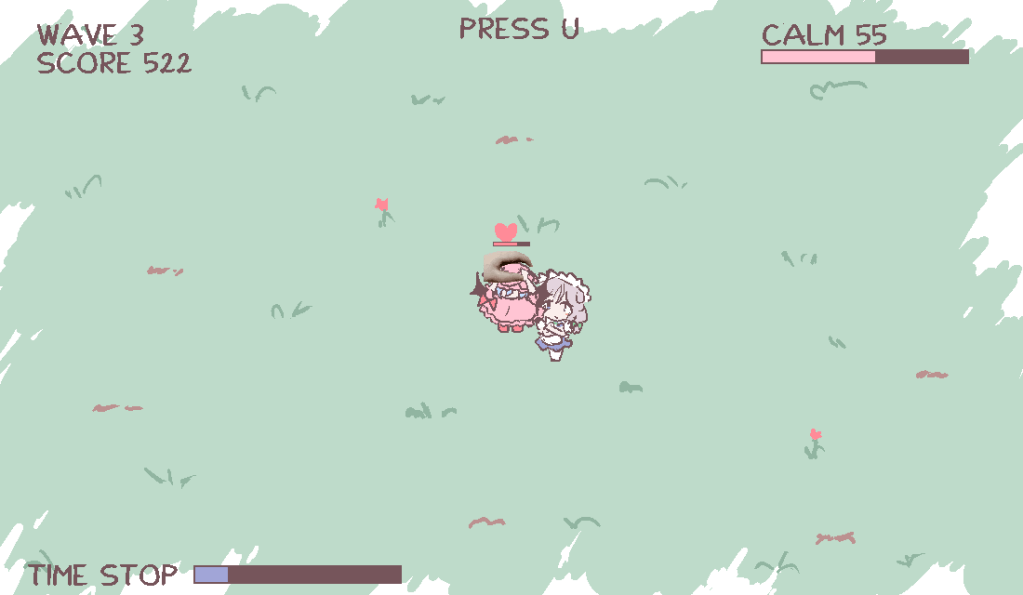
The user interface is clean and straightforward, displaying essential meters for the current wave, Remilia’s Calm percentage, and your Time Stop meter. Menus are easy to navigate using standard keyboard inputs. However, where the technical side stumbles is in its total lack of basic quality-of-life options. There is no options menu at all, which means no rebindable key settings, no audio toggles, and no accessibility options—what you see is strictly what you get.
Visually, the game utilizes a bright, pastel-colored grass backdrop that contrasts well with the character sprites and enemy models, making interactive objects and incoming threats easy to distinguish. The overall pixel-art aesthetic is consistent and fitting for a lighthearted fan-game, with one glaring exception: when you press the button to comfort Remilia, a realistic, photorealistic hand appears on screen. It completely clashes with the established 2D pixel art style, feeling strangely out of place—though given the tone, it comes across as an intentional design joke rather than an accident.
The animation work is functional, using standard 2D sprite loops typical for an arcade jam project. Collision detection is reliable, so you won’t find characters clipping through walls or floating unnaturally. However, the game lacks heavy visual impact. Attacks and hits feel a bit floaty due to a lack of camera shake or dynamic lighting; when enemies are defeated, they simply flash red and pop into minor particle bursts.
Mechanics
When you look at the core gameplay loop, Stay Here keeps things simple and focused. You control Sakuya from a top-down perspective, tasked with clearing incoming waves of enemies while staying close enough to defend Remilia.
Your primary attack is throwing knives in four directions using the IJKL keys while moving with WASD. The knives have a limited travel range, which creates an intentional spacing constraint. When large clusters of enemies close in, relying solely on standard attacks becomes tricky. To offset this, you have access to a time-stop mechanic mapped to the spacebar, allowing you to freeze the action, reposition, and clear out high-priority targets before the meter depletes.
The main mechanical gimmick revolves around managing Remilia’s state. As enemies approach her, her “Calm” percentage drops. Pressing the U key triggers a dedicated action to comfort Remilia, which restores her status meter. This forces you to continuously juggle offensive crowd control with defensive upkeep—if you focus entirely on clearing enemies and neglect Remilia, you will hit an immediate game over.
While the mechanics work together effectively, the execution has a few noticeable quirks:
- Slippery Movement: Sakuya’s movement physics feature noticeable momentum and friction when coming to a stop, which can make precise positioning feel slightly loose during chaotic waves.
- Control Layout: Splitting movement (WASD) and four-way shooting (IJKL) across both hands requires a bit of dexterity, especially since there is no interactive tutorial to introduce the setup naturally.
- Lack of Rebinding: Because key bindings cannot be remapped, players are locked into the default control scheme regardless of preference.
The enemy design provides variety through behavioral patterns rather than stat inflation, featuring a mix of fast melee chasers and ranged attackers. Because the main story mode only lasts about half an hour, the mechanics don’t outstay their welcome or feel overly repetitive. For players seeking a harder mechanical challenge, the endless score-attack mode strips away the narrative breaks and tests how long you can sustain the juggling act against escalating waves.
Sound Design and Music
When you turn your attention to the audio presentation of Stay Here, the game leans heavily into retro, 8-bit aesthetic choices that align with its pixel-art visuals. The sound effects rely on straightforward chiptune audio cues. Basic actions—such as throwing knives, selecting options in the menu, and freezing time—are accompanied by simple, repeating 8-bit sound effects. While these effects suit the overall indie game jam design, impact feedback remains somewhat minimal. Attacks don’t feature heavy audio crunch or dynamic volume variations, relying instead on quick particle pops and standard hits to signal success.
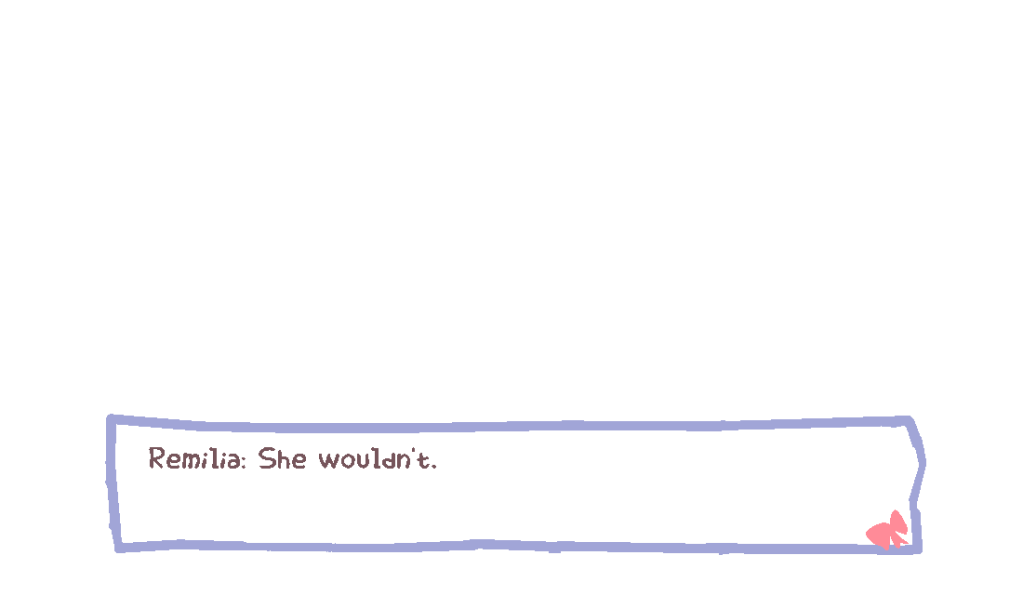
Because the game takes place on a single-screen, top-down arena where every threat is instantly visible, directional audio mixing and 3D spatial panning aren’t factors. What you hear matches what you see on screen without cutoffs or spatial distortion. On the musical side, the soundtrack does a solid job of matching scene context. Narrative dialogue scenes feature a quiet, understated melody between Sakuya and Remilia, which cleanly transitions into an energetic, fast-paced chiptune track once the enemy waves begin.
While the music tracks utilize relatively short, looping melodies, repetition never becomes an issue because the main story mode lasts only about thirty minutes. Additionally, the audio mixing keeps background tracks at a balanced volume level, ensuring that written dialogue boxes and visual cues remain clean and unobstructed. Finally, as a classic text-driven arcade title, there is no voice acting, keeping the presentation entirely focused on retro sound effects and music.
Narrative Cohesion
In a brief, fast-paced arcade game, balancing story setup with non-stop action can be tricky. Story moments in Stay Here are delivered entirely through brief, written dialogue boxes interspersed between enemy waves. The premise establishes Sakuya Izayoi as Remilia Scarlet’s devoted protector, who steps up the moment a sudden onslaught interrupts their quiet scene. From a narrative perspective, Sakuya’s immediate transition into combat completely matches her role—there is no disconnect between her character motivation and what you’re doing in gameplay.
The game avoids artificial padding or massive text dumps. Instead of forcing you to wade through menus of dry lore files, the backstory and immediate stakes are presented quickly and naturally right at the start. Furthermore, character interactions remain consistent with established Touhou Project lore, focusing entirely on their relationship without falling into unnatural tutorial exposition during dialogue.
Because the game takes place within a single-screen arena, it also avoids typical open-world or level-design tropes that break immersion, such as invisible barriers or arbitrary progression blockers. The flow from narrative setup to active wave defense is linear and direct. While the story is simple and linear—lacking branching choices or multi-outcome moral decisions—it serves its purpose well for a 30-minute jam entry, keeping the focus entirely on the core objective of protecting Remilia.
Engagement and Fun
When evaluating a game designed for a quick arcade session, the core question is simple: does it grab your attention immediately, or does it feel like a chore? Stay Here skips long intro sequences and intrusive tutorials. The moment you finish the short opening scene, you’re immediately thrust into the action with a clear, single goal: keep Remilia calm while surviving incoming enemy waves. There are no massive, empty maps, no inventory spreadsheet management, and no forced side objectives to stall the pacing.
The main driver of engagement comes from the dual objective design. You aren’t just clearing out enemies with knife attacks; you have to actively keep an eye on Remilia’s Calm meter. Because enemies naturally lower her status as they close in, you’re forced to make quick tactical choices: do you use your time-stop ability to thin out a cluster of ranged attackers, or do you save it to sprint back and press the U key to comfort Remilia before her meter drops to zero?
While the mechanics are straightforward and rigid—offering no alternate weapon sets or skill trees—the flexibility comes from how you manage crowd density and positioning. The slippery movement physics and short knife range add a layer of challenge that keeps encounters tense, but immediate retries mean that failing a wave never feels overly punishing. Because the entire story mode spans roughly thirty minutes, the core gameplay loop remains fast, focused, and free of artificial padding from start to finish.
Replayability
When evaluating a game that takes roughly thirty minutes to clear, the question becomes whether there is a compelling reason to return once the credits roll. In Stay Here, replayability is handled entirely through score attack rather than mechanical variety. The game does not feature alternative character classes, unlocking skill trees, or branching narrative paths that change how subsequent playthroughs play out. The main story mode is strictly linear, following the same sequence of enemy waves every time.
However, the game provides extended value through its Endless Score-Attack Mode. Once you complete the narrative, this mode strips away the dialogue breaks and tests how long you can survive against continuous, escalating enemy waves. Coupled with an online leaderboard, it shifts the focus from narrative completion to high-score competition. While it lacks deep progression systems or randomized elements, Stay Here offers a clean, arcade-style replay loop focused entirely on skill mastery and high scores.
Learning Curve
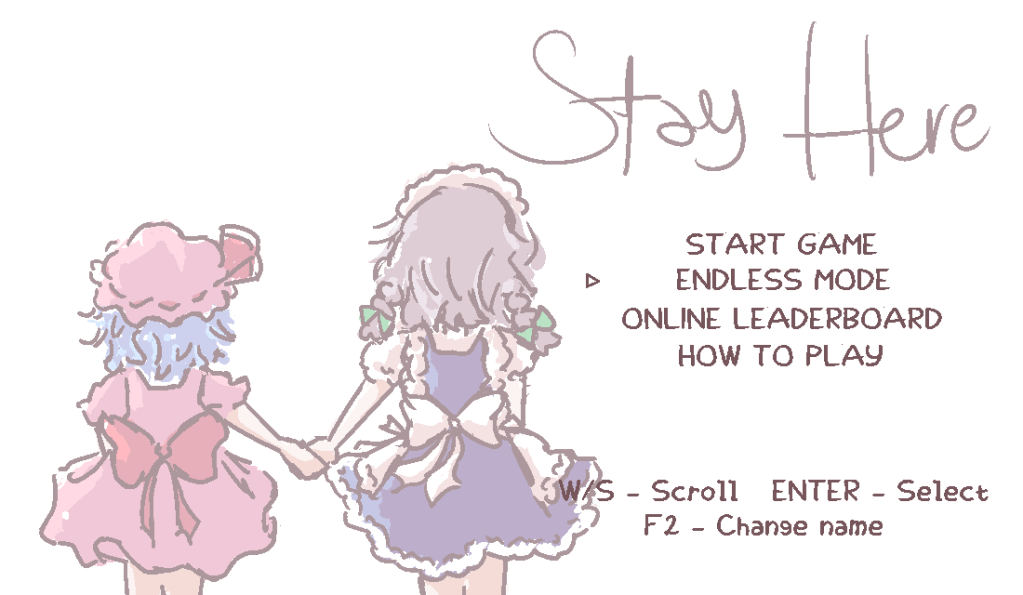
In a tight, half-hour arcade game, how a game introduces its rules determines whether a player gets hooked or immediately frustrated. Stay Here skips intrusive mid-game tutorials and forced action checks. It doesn’t pause the gameplay to tell you to press a button, nor does it throw walls of text at you before you can even move. Instead, all key bindings and mechanics are listed in an optional “How to Play” section accessible from the main menu. You are expected to read the controls, jump in, and learn through direct play.
The core mechanics—movement, directional knife throws, freezing time, and comforting Remilia—are simple on paper. However, the initial hurdle comes from the control layout and movement physics. Managing movement on WASD while directing attacks with IJKL takes some coordination. Combined with Sakuya’s slippery movement momentum, positioning yourself under pressure during early waves can feel slightly awkward until you get a feel for the friction.
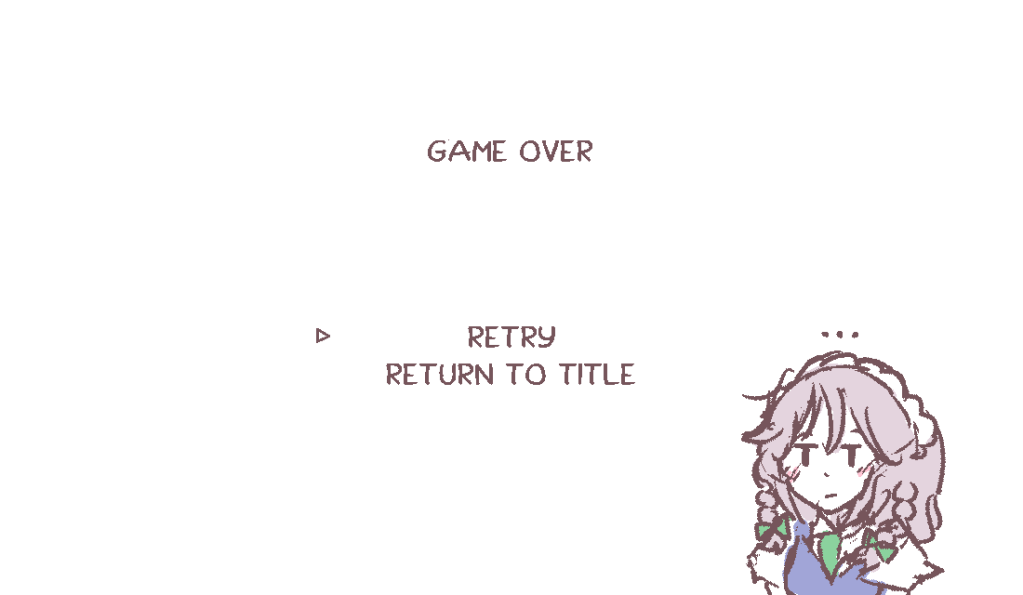
Where the game succeeds is in its clarity of failure. There are no untelegraphed instant-death traps or hidden mechanics that punish you for lack of outside knowledge. When you fail a wave, the reason is always obvious: you either let enemy crowds overwhelm Sakuya, or you failed to manage Remilia’s Calm meter in time. Because difficulty scales wave by wave gradually, and because retries allow you to attempt a failed wave immediately with a reset meter, the game gives you room to adapt to its controls without wasting your time.
Feel of Play
Finally, let’s look at the feel of play—how all these mechanical choices translate to the actual sensation of controlling the game. Input responsiveness in Stay Here is immediate. Button presses for throwing knives, stopping time, and triggering the comfort action register without noticeable input lag, which is critical for an arcade title operating at a fast pace.
However, the defining physical characteristic of the gameplay is Sakuya’s movement physics. There is a distinct friction momentum when coming to a stop, giving her movement a slippery quality. In tight defensive situations, stopping or changing direction precisely requires you to account for this slide, which can occasionally lead to accidental collisions if you misjudge the inertia.
When it comes to visual and physical feedback, the game relies on classic, lightweight arcade conventions. Throwing knives can be done continuously while moving without locking Sakuya into rigid attack animations, keeping combat fluid. Upon hitting an enemy, feedback consists of brief red visual flashes and small particle pops accompanied by retro 8-bit sound cues, rather than heavy hit-stop frames or dynamic screen shake.
Because the action takes place across a flat, open arena free from geometric hazards, snags, or camera bobs, the environment itself stays out of your way. The feel of play ultimately relies on the rhythm of movement momentum, rapid knife throws, and time management.
Final Verdict
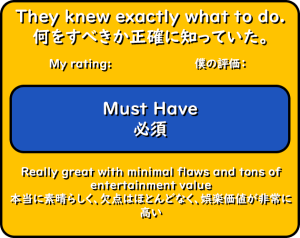
When you take a step back and look at Stay Here as a whole, it succeeds in doing exactly what a game jam title should do: it delivers a tightly focused, well-executed premise without bloating the experience with filler. Its technical stability is rock solid, with smooth performance and rapid load times. While its slippery movement physics and non-rebindable key options introduce minor friction, the core mechanical rhythm—juggling directional knife attacks, time stops, and comforting Remilia—creates an engaging, fast-paced challenge that respects the player’s time.
Whether you play through the story mode for a quick half-hour session or test your survival skills on the endless mode leaderboard, the game knows its strengths and delivers them efficiently. Ultimately, Stay Here scores a 7.5 out of 10, placing itself firmly in the Must Have category for arcade fans and Touhou enthusiasts alike. It’s a smart, polished indie project that knows precisely what it wants to be.
If you’d like to try the game yourself, I have the link here:
https://gluesnacc.itch.io/stay-here
Discover more from Drillimation Systems
Subscribe to get the latest posts sent to your email.


hey
LikeLike
Gay Potion at 3AM hmm where can I buy one
LikeLike
A top-down action game has to make the player, enemies, and projectiles readable before the pixel art can simply look cute. The four-way attacks and time-stop mechanic sound especially dependent on clear silhouettes and distinct colour groups. That visual hierarchy probably helps the short game feel immediately understandable.
LikeLike