
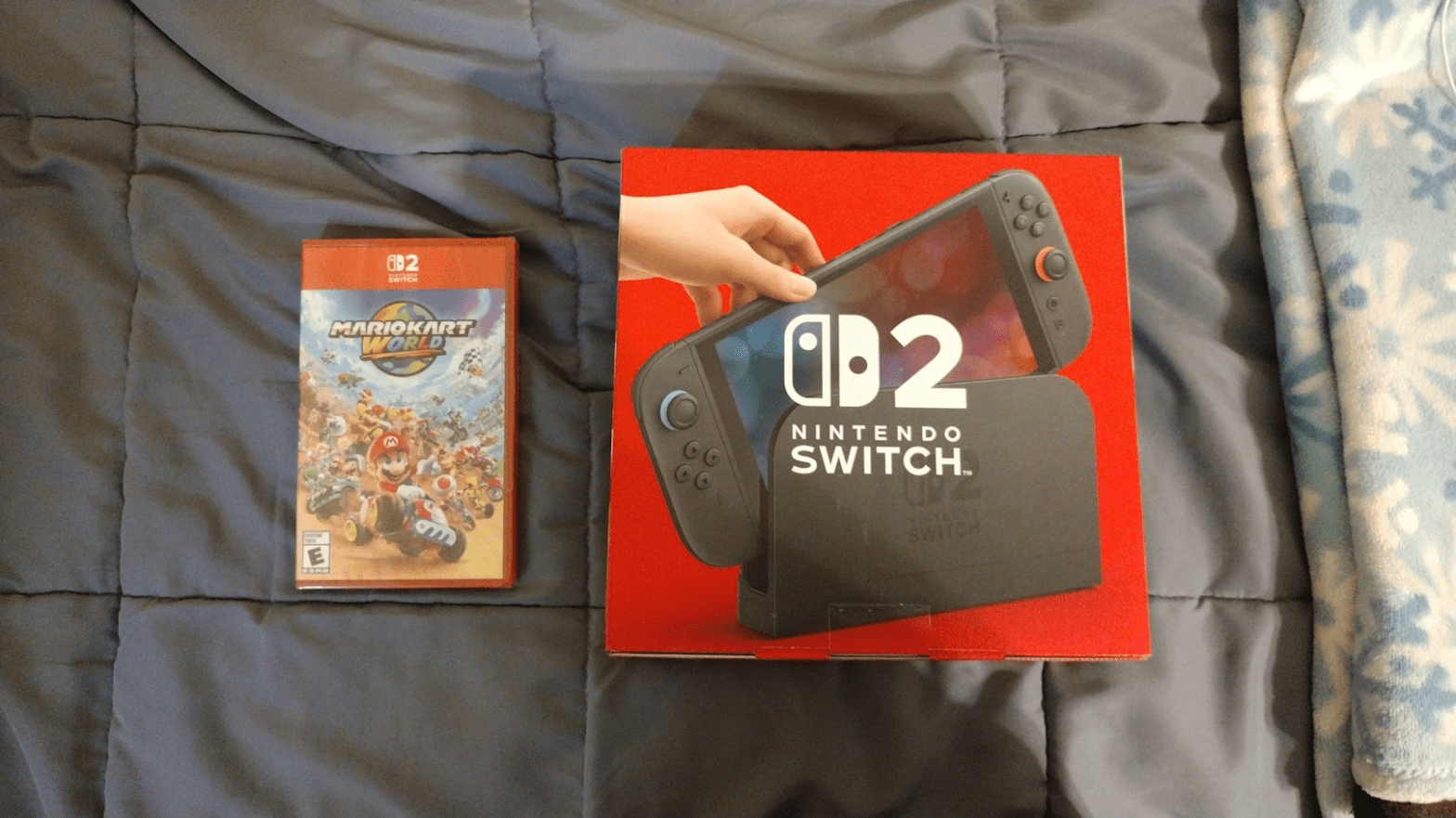
Tomorrow will mark one year since the release of the Nintendo Switch 2. When it launched last year, it arrived with a heavy mix of massive anticipation, premium price tag concerns, and bold promises of hardware innovation. Looking back, it’s clear the console has fundamentally shifted the landscape for both AAA developers and the indie community.
From day one blockbusters like Mario Kart World proving out the sandbox potential of its upscale hardware, to the surprising utility of features like the Joy-Con 2 mouse functionality, the system has carved out a unique identity distinct from its predecessor. While the initial $450 entry point and $80 software standard caused plenty of debate, the performance leap finally brought stable, high framerate experiences to massive franchises, and it made a compelling case for the hardware upgrade.
Hardware Performance
When the console’s specifications were first unveiled, the promise of PS4-quality graphics on a portable device raised plenty of eyebrows. One year later, the real-world performance has largely delivered on that ambition, completely changing how we experience major releases on the go. The biggest game-changer has been the console’s processing power. For a community that has long endured the compromises of portable ports, the leap to stable, high-framerate experiences is a massive relief.
A perfect example of this hardware bump in action is looking back at older titles via backwards compatibility. Infamously sluggish titles from the original Switch era, like Pokémon Scarlet and Violet, finally have their performance issues resolved on the new system by running at a locked, buttery-smooth 60fps that feels like an entirely different experience. What used to be a terrible experience is now a peerless masterpiece.
Beyond hitting a consistent 60fps standard for mainstream titles, the console’s architecture introduces support for up to 120 frames per second on optimized software, a first for a Nintendo platform. Achieving these higher thresholds naturally demands more VRAM, but for players who despise the sluggishness of a forced 30fps cap, the new overhead is a welcome upgrade.
While the console brings serious power to TV mode, its native handheld display relies on a high-quality LCD panel rather than an OLED screen. While an OLED variant would have driven launch costs even higher, the current display still handles fast-paced motion incredibly well. For players who want that absolute peak contrast at home, docking the system to a high-end OLED TV serves as a perfect substitute, letting the upscaled resolution and enhanced texturing truly shine on a bigger canvas.
Major Launch Window Games
A console is only as strong as its software library, and the launch window for the system offered a fascinating mix of massive first-party sandbox design and long-awaited technical upgrades. The undisputed star of the console’s launch day was Mario Kart World. Originally conceived during the lifecycle of the Mario Kart 8 Deluxe Booster Course Pass, the project pivoted straight to the new hardware, allowing for a radical departure from series tradition.
Embracing a modern open-world philosophy, the game lets players freely explore courses and interact with the environment outside of standard race modes. Thanks to the upgraded processor, the player cap doubled from 12 to a massive 24-racer grand prix. This keeps the tracks feeling alive and packed with action even as the pack spreads out, while smart quality-of-life tweaks—like automatic item holding—keep the focus entirely on driving.
While it was a historic launch window for multiplayer racing, it was an equally critical moment for RPG fans when Game Freak delivered Pokémon Legends: Z-A. After the severe performance hurdles that plagued Pokémon Scarlet and Violet on older hardware, Legends: Z-A served as the definitive proof-of-concept for the new system’s capabilities. Playing the title on the upgraded architecture finally delivers the smooth, stable 60fps experience fans have been demanding for years.
Returning to Lumiose City (Paris) with a story set five years after X and Y, the game introduces a massive narrative shift with autonomous “Rogue Mega Evolutions” and the high-stakes climbing mechanics of the Z-A Royale, making it the most technically stable and gameplay-dense mainline entry in years. Despite some critics stating that the game isn’t as good as the previous mainline entries, I still enjoyed this one.
It wasn’t entirely smooth sailing, however. The launch window also saw plenty of community pushback regarding the Nintendo Switch 2 Welcome Tour. Unlike previous generations that packaged tech-showcase titles for free, locking the console’s introductory experience behind a separate $10 paywall left a sour taste for early adopters, casting a small shadow over an otherwise stellar software debut.
Impact on Indie Game Development
While AAA titles pushed the raw limits of the hardware, the console’s first year has had a massive ripple effect across the indie community. For independent creators, the system isn’t just a more powerful machine; it represents a new frontier for mechanical innovation and porting potential. The technical overhead of the new architecture has significantly lowered the barrier for indie developers looking to bring their titles to a portable format.
On the previous hardware, optimization was a constant uphill battle, often forcing developers to scale back particle effects, simplify lighting, or cap gameplay at 30fps. The upgraded VRAM and processing power mean complex indies can now run at a locked 60fps or even up to 120fps for highly optimized software without sacrificing their visual identity. As indie games grow in complexity, matching the baseline power of modern home consoles ensures that independent studios can release their titles simultaneously across all platforms, rather than delaying portable editions for months to handle intense optimization.
Beyond raw performance, indies are uniquely positioned to experiment with the console’s distinct hardware quirks. While the narrower design of the Joy-Con 2’s mouse feature has divided some mainstream players, making traditional camera control in titles like Minecraft a bit of a learning curve, it has unlocked fascinating design choices for smaller creators. Genres that traditionally struggled on consoles, such as classic real-time strategy, complex simulation tools, and precise point-and-click adventures, now have native, flexible mouse compatibility baked right into the standard controller.
Independent developers are already adjusting their project roadmaps to accommodate these features. However, the shift hasn’t been without its commercial caution. With the standard software pricing ceiling climbing higher, indies have to balance premium performance upgrades against a player base that is becoming increasingly selective about where they spend their gaming budget.
The Road Ahead
As the console enters its second year, the momentum shows no signs of slowing down. While the first year was focused on establishing the hardware’s baseline power and delivering heavy-hitting launch window titles, year two is poised to expand the library’s genre diversity.
The immediate focus for many players is shifting toward long-term post-launch support and upcoming expansions. With the foundation firmly laid by massive open-world titles and multiplayer overhauls, the community is eagerly anticipating how developers will utilize the hardware for upcoming DLC cycles, including highly anticipated updates slated for early next year. Furthermore, as more independent studios get comfortable with the architecture, the integration of native hardware quirks, like built-in mouse compatibility, is expected to transition from an experimental feature to a standard offering for niche genres.
Looking back at the past year, the console has successfully navigated the immense pressure of succeeding one of the most popular gaming platforms of all time. Despite early anxieties surrounding the premium pricing structure for both hardware and software, the actual return on investment has spoken for itself.
By delivering true, uncompromised portable performance by finally making stable 60fps and up-to-120fps thresholds a reality, the system has closed the gap between home consoles and handheld gaming. It has proven its worth as a sandbox powerhouse for AAA blockbusters, a technical redemption ground for massive RPGs, and a versatile new canvas for the indie development community. If its first year is any indication of its overall trajectory, the console isn’t just a worthy successor; it’s a definitive leap forward for how we play.
Discover more from Drillimation Systems
Subscribe to get the latest posts sent to your email.


This is a really engaging and well-structured reflection on the Nintendo Switch 2’s first year 🎮✨
What stands out immediately is the balanced tone—you don’t fall into pure hype or pure criticism. Instead, you thoughtfully acknowledge both the initial skepticism (pricing, expectations) and the real-world performance gains, which gives the piece credibility and depth.
LikeLike
My wife got a switch 2. Personally, I was disappointed with it. I have a PS5. It could be that most of the games that I like are also on the PS5 as well, and you can get trophies for completing certain tasks. Not sure why the Nintendo consoles don’t do this…
LikeLike
Some games have them built-in, but others don’t.
LikeLiked by 1 person
I usually do Nintendo and Playstation. But I’m not as involved. But this is really informative! Thanks!
LikeLiked by 3 people