

NOTE: This game is currently in alpha testings and only applies to this version. Actual in-game content may change and this review may not be reliable as time goes on.
Welcome to another digital descent into the maddening, beautiful, and occasionally bewildering world of jam game development, where we find ourselves staring down the barrel of Bomberfrog. It is another project that managed to find its way into the frantic arena of Bullet Hell Jam 7, promising us a two-minute burst of high-speed survival where your primary lifeline is also your most precious commodity. It’s a fascinating, if raw, study in risk and reward – a horizontal shooter that asks us to treat our own weaponry as a fragile extension of our existence, proving once again that in the right hands, minimalism isn’t just an aesthetic choice; it’s a desperate, heart-pounding survival strategy. So, let’s peel back the layers on this prototype and see if this little frog really does have the legs to leap into the big leagues of the genre.

What to Know
Critic’s Lens
Bomberfrog is a taut, adrenaline-fueled experiment in mechanical fragility that succeeds despite its modest scale. By ingeniously tying the player’s primary offensive capability directly to their life expectancy, developer Brett Chalupa crafts a high-tension loop of risk and reward that feels both dangerously immediate and strategically profound. It is a lean, mean, danmaku machine that demands absolute precision, turning every encounter into a frantic, heart-pounding dance with annihilation.
Player’s Heart
Bomberfrog is a total blast. It’s easy to pick up but masterfully tough to win, with gorgeous, dense bullet patterns that make every clear feel like a genuine achievement. The “bomb as health” mechanic is a stroke of genius that adds a layer of depth we didn’t know we needed – even if we sometimes struggle to resist the urge to hoard those precious chips. It’s a short, sweet, and highly addictive bite-sized challenge that has us hooked and begging for the full release.
The Big Picture
Technical and Creative Polish
When examining the technical foundation of Bomberfrog, it is clear that the development, conducted within the Usagi Engine, provides a stable and responsive experience. The game maintains a high level of performance, which is essential for a genre that relies on frame-perfect inputs and precise hitboxes.
Creatively, the polish is evident in the thoughtful implementation of the “bomb as health” mechanic. The visual feedback, specifically the expansion of the bomb radius and the distinct chip-collection particles, creates a cohesive sense of internal logic. The sound design is another highlight; by utilizing multiple randomized variants for repetitive sound effects and applying high and low-pass filters, the developer has successfully mitigated the potential for audio fatigue that often plagues high-intensity shooters. While the current build is limited to a single stage, the structural integrity and the deliberate, balanced design choices suggest a refined approach to the jam development process.
Mechanics
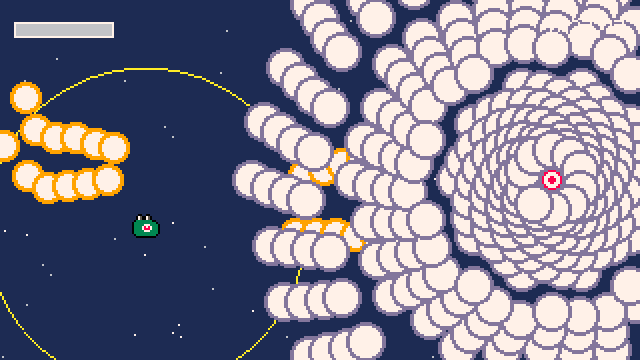
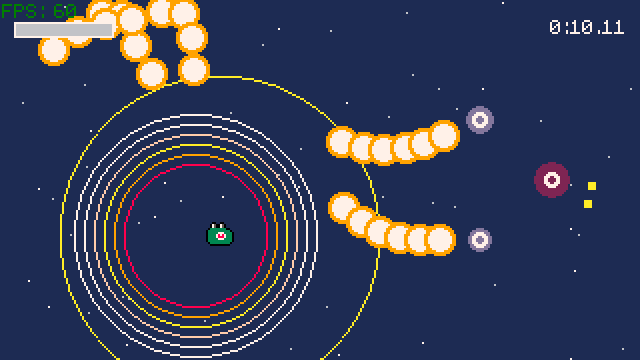
The core gameplay loop of Bomberfrog is centered on a high-stakes management system where the player’s primary offensive tool, the bomb, serves a dual purpose as their health bar. This design choice creates a constant state of flux, forcing players to balance the necessity of clearing the screen with the risk of depleting their own defensive buffer.
When enemies are defeated, they release chips that the player must collect to replenish their bomb meter. The game introduces a tactical nuance through a proximity-based collection system: while firing, the chip-pull radius is intentionally restricted, encouraging players to cease fire and maneuver carefully to gather resources. This mechanism effectively forces a rhythmic engagement with the game, where moments of aggressive clearing must be punctuated by periods of focused, non-firing navigation. The implementation of this “float-extend” style mechanic, combined with enemy patterns that reward speed and precision, provides a structured environment that prioritizes strategic risk-taking over passive survival.
Sound Design and Music
The developer has implemented a deliberate approach to manage the potential for auditory fatigue, which is a common challenge in the bullet-hell genre. To address this, the sound effects are not static; rather, the game utilizes multiple randomized variations for each effect, which helps to maintain variety throughout intense gameplay sessions. Furthermore, the application of high-pass and low-pass filters to these sounds effectively softens their presence, ensuring they remain clear without becoming overly piercing or abrasive during sustained play. The musical backdrop, provided by Chromatic Arcana, complements the action with a consistent energy that keeps the pace driving forward without distracting from the primary focus of dodging and managing the bomb meter. Overall, it is a functional and well-considered audio suite that serves the gameplay mechanics reliably.
Narrative Cohesion
It is important to note that the game functions primarily as a mechanical showcase rather than a story-driven experience. In the context of a game jam project, specifically one built within a ten-day timeframe, the absence of an elaborate plot is not a deficit, but a design efficiency. The game establishes its narrative entirely through the core gameplay loop: you are a frog, you have bombs, and you must survive. This minimalist approach allows the player to immediately engage with the challenge without being bogged down by exposition or complex world-building. For a horizontal shooter, the premise is clear, functional, and provides sufficient context for the high-intensity action that follows. It is a focused design choice that keeps the player’s attention exactly where it needs to be: on the screen, the threats, and the survival tactics.
Engagement and Fun
The gameplay loop succeeds primarily by establishing a clear, high-stakes incentive structure. The “bomb as health” mechanic is the central driver of engagement, as it forces the player to constantly negotiate between the desire for offense and the need for survival. This creates a state of consistent focus, as the player must navigate dense patterns while managing the resources required to remain in the game.
Player feedback highlights the satisfaction found in the wave design and the visual clarity of the bullet patterns. The “chip” collection system, which rewards proximity and precise movement, adds a layer of tactical depth that transforms standard survival into a more active, rhythmic experience. Even within the scope of a single-stage prototype, the game achieves a balance where the difficulty feels earned, leading to a “just one more try” quality that keeps the experience engaging throughout its brief duration. It is a well-tuned system that respects the player’s time and provides a rewarding, coherent challenge.
Replayability
When assessing the replay potential, it is important to acknowledge that the game is currently a single-stage prototype. Despite this limited scope, the title encourages repeat play through a clear, time-based scoring system. By tracking clear times, the game provides an objective metric that allows players to compare their performance against others, which is a staple of the arcade-style shooter genre.
The meta-game also benefits significantly from the risk-reward nature of the bomb-as-health mechanic. Players are incentivized to return to the stage to refine their bomb usage, optimize their movement patterns, and discover more efficient ways to collect chips while navigating dense bullet patterns. While the current build is brief, these elements create a structure where the pursuit of a faster completion time serves as a sustainable hook for those interested in score-attack gameplay. It provides a functional foundation that supports multiple playthroughs, even in its present alpha state.
Learning Curve
The learning curve is structured around a gradual introduction to its core risk-reward mechanics. While the game provides immediate feedback on basic controls, moving, and shooting, the true complexity lies in mastering the “bomb-as-health” system. For newcomers to the genre, the game’s initial waves serve as a controlled environment to practice dodging while simultaneously learning the necessity of aggressive positioning to collect chips.
The requirement to cease firing to increase the chip-pull radius introduces a tactical shift that necessitates practice; players must learn to identify brief windows of opportunity to maneuver safely rather than relying solely on continuous fire. While some users may initially find the proximity requirements for chip collection challenging, given the speed of enemy projectiles, the game’s concise, single-stage design allows for rapid iteration. This structure effectively encourages players to learn from failed attempts and refine their movement and bomb-management strategies, providing a manageable bridge between basic survival and more advanced, score-oriented play.
Feel of Play
The tactile experience is defined by its responsiveness and the intentional weight of its primary mechanics. When operating within the Usagi Engine, the movement feels precise, which is a requirement for a genre where the margin for error is consistently thin. The distinction between the spread and focus fire modes provides a clear, functional difference in how the ship handles, allowing for both wide-area clearing and concentrated damage output against larger targets.
Perhaps most significant to the feel is the way the bomb system interacts with the player’s movement. Because the bomb meter is tied to health, there is a tangible sense of consequence to every maneuver; the ship never feels overpowered or invincible. Instead, the gameplay necessitates a rhythmic, almost deliberate pace, where the player must constantly weigh the necessity of aggressive movement against the need to maintain a defensive buffer. It is a tight, well-calculated loop that prioritizes disciplined input over frantic button-mashing, resulting in a cohesive experience that feels focused, balanced, and structurally sound for a prototype build.
Final Verdict

When evaluating this title, it is best understood as a focused and mechanically sound prototype. While it is limited in scope and contains only a single stage, it successfully demonstrates a compelling, high-stakes risk-reward loop that is both easy to understand and difficult to master. The technical foundation, built within the Usagi Engine, is responsive, and the deliberate approach to sound design and wave construction suggests a well-considered development process.
On the scale, it’s still good, but I’m not saying it’s great. In a more conventional format, this translates to a 7 out of 10. It is a polished, highly playable experience that, while brief, provides a satisfying challenge for those interested in score-attack shooters. It is an impressive piece of work for a ten-day game jam submission and serves as a promising proof-of-concept for a more expansive future project. Some of the flaws that I want to see corrected include having multiple stages, and when a game only has one stage, it lacks variety and narrative value.
If you’d like to try the game, I have the link here:
https://brettchalupa.itch.io/bomberfrog-alpha
Discover more from Drillimation Systems
Subscribe to get the latest posts sent to your email.
 Drillimation Systems
Love your writing style. It’s concise, informative, creative.
LikeLike
Great you have time to write this. happy day.
LikeLike
I love games that encourage you to beat your own high score!
LikeLike
I love old games 🎮. Happy day 🎉
LikeLiked by 2 people