
Family-oriented games usually see overwhelming financial success, and more than half of all games rated by the ESRB receive E and E10+ ratings. But on the dark side, the Mature rating has become the default setting for many AAA developers, whether they release their games on Nintendo’s consoles or their competitors PlayStation and Xbox, the latter of which they usually do.
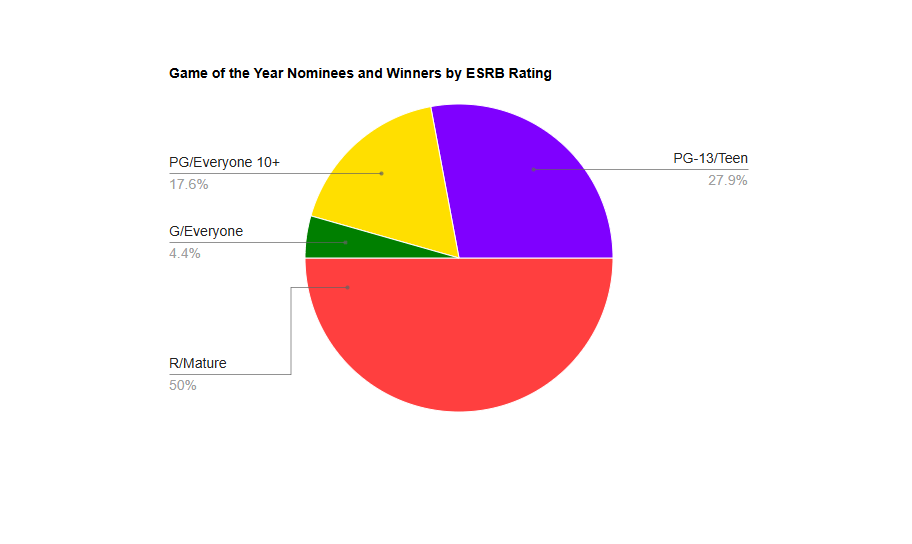
We took a look at every game that has won or been nominated for Game of the Year at the Game Awards, and what might surprise you is that, out of the 12 that won and the 68 that have been nominated, more than half received restricted ratings. There are a few key findings in the reasons for these ratings:
- Extinction of family-oriented games: The Game Awards has its own award category for family-oriented games. Games rated E and E10+ usually go here, but there have been a few Teen-rated titles that have accepted nominations, such as It Takes Two. In the years before the ESRB was established, the Nintendo Entertainment System was a staple of family entertainment. Today, Game of the Year nominees are representing less than that, forcing parents to choose games rated Teen and below, or nothing at all.
- The Profit Paradox: While M-rated games are numerous for all nominations, E and E10+ games earn more profits. The industry’s insistence on M-rated production is a creative ego choice by the directors and/or producers and is not a fiscal one.
- The Infiltration of Violence: Four in five games with Mature ratings often contain gratuitous violence that serves little to no narrative purpose other than shock value.
The table below shows all four ESRB ratings, how much they account for, and the primary reason for their rating:
| Rating | Accounts for (as of 2025) | Primary Reason |
|---|---|---|
| E | 52% | N/A |
| E10+ | 15% | Mild language or thematic material |
| T | 23% | Intense action or suggestive content |
| M | 10% | Pervasive language or graphic violence |
But in terms of nominees (as of 2025), there is one big surprise:
- More than half of them (50.0%) have been rated R/Mature, and that accounts for 34 games.
- Less than 28% came back PG-13/Teen, and that accounts for 19 games.
- Less than 18% came back PG/Everyone 10+, and that accounts for 12 games.
- Only 4% have been rated G/Everyone, and that accounts for three games.
The table below shows the primary reason each Game of the Year winner received their respective rating:
| Year | Game | Rating | Reason |
|---|---|---|---|
| 2014 | Dragon Age: Inquisition | R (M) | Rated R for strong violence, nudity, sexual content, and language. |
| 2015 | The Wither 3: Wild Hunt | R (M) | Rated R for graphic sexual content and nudity, bloody violence, and pervasive language. |
| 2016 | Overwatch | PG-13 (T) | Rated PG-13 for sci-fi action and some bloody images. |
| 2017 | The Legend of Zelda: Breath of the Wild | PG (E10+) | Rated PG for fantasy violence and mild suggestive material. |
| 2018 | God of War | R (M) | Rated R for intense sequences of bloody violence and language. |
| 2019 | Sekiro: Shadows Die Twice | R (M) | Rated R for strong violence and bloody images. |
| 2020 | The Last of Us Part II | R (M) | Rated R for brutal graphic violence, grisly images, nudity, sexual content, drug use, and pervasive language. |
| 2021 | It Takes Two | PG-13 (T) | Rated PG-13 for some violence and language. |
| 2022 | Elden Ring | R (M) | Rated R for violence and bloody images, language, and some suggestive content. |
| 2023 | Baldur’s Gate 3 | R (M) | Rated R for graphic violence and gore, sexuality and nudity, and language. |
| 2024 | Astro Bot | PG (E10+) | Rated PG for fantasy action and some crude humor. |
| 2025 | Clair Obscur: Expedition 33 | R (M) | Rated R for strong violence, bloody images, language, and some suggestive material. |
In short, the nominees need to be overhauled for future events. The current system serves the interests of studios that wish to market adult aesthetics to teenagers rather than the parents it was designed to protect. We call on major AAA studios to commit to a 25% increase in E and E10+ titles over the next few years. When a studio chooses the Mature rating, they aren’t just choosing a label, but locking the doors to the typical family.
Discover more from Drillimation Systems
Subscribe to get the latest posts sent to your email.
 Drillimation Systems
This is a sharp, well-argued piece that takes a familiar topic and pushes it into more thoughtful territory.
What stands out first is your ability to balance data with interpretation. You’re not just listing numbers—you’re drawing meaning from them. The contrast you highlight between commercial success and creative direction (“The Profit Paradox”) is especially compelling. It challenges a common assumption and forces the reader to reconsider what actually drives the industry.
LikeLike