
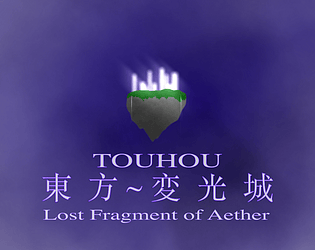
Today, we’re diving into another curious Touhou Project fangame under the traditional danmaku shooter genre known as Touhou: Lost Fragment of Aether. While every AAA studio is busy tainting every digital crevice with battle passes and monetization, the independent scene usually offers a sanctuary of free entry points. Yet, we must still ask if this specific experience is actually good, or just another attempt to distract us from the impending heat stroke of the universe with pretty patterns and danmaku misery. Built in Turbowarp, the digital equivalent of constructing a cathedral out of popsicle sticks and sheer unbridled spite, this project is a fragment of aether that is a hidden gem rather than just another detritus cluttering the mountains of Gensokyo.
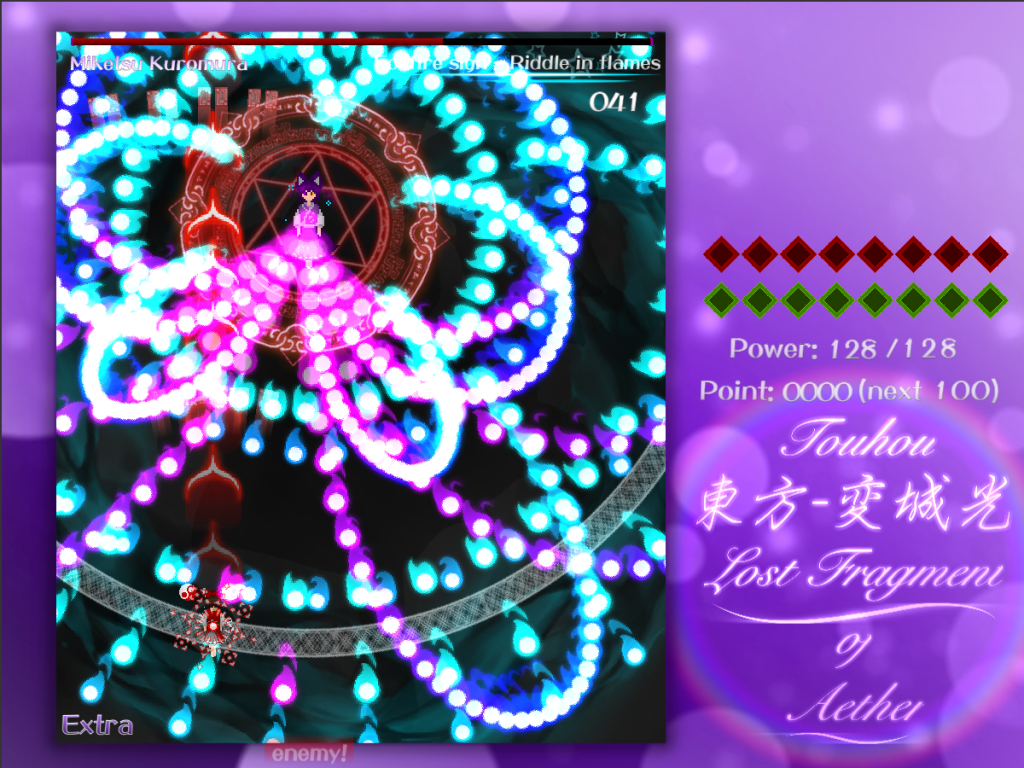
Gameplay
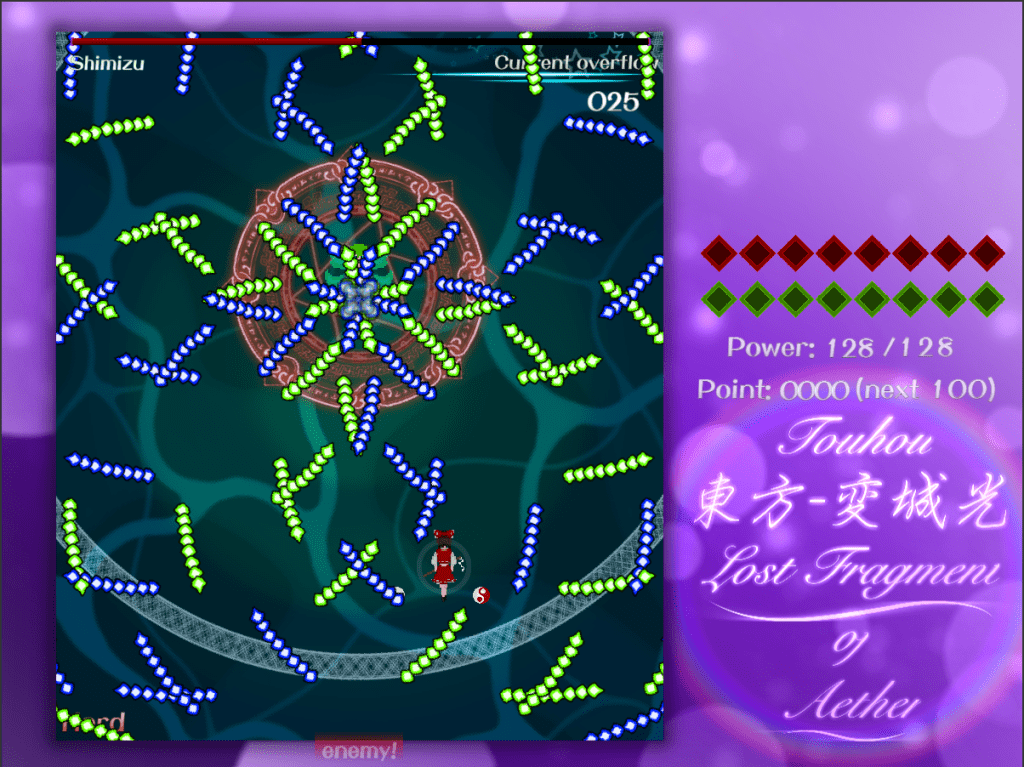
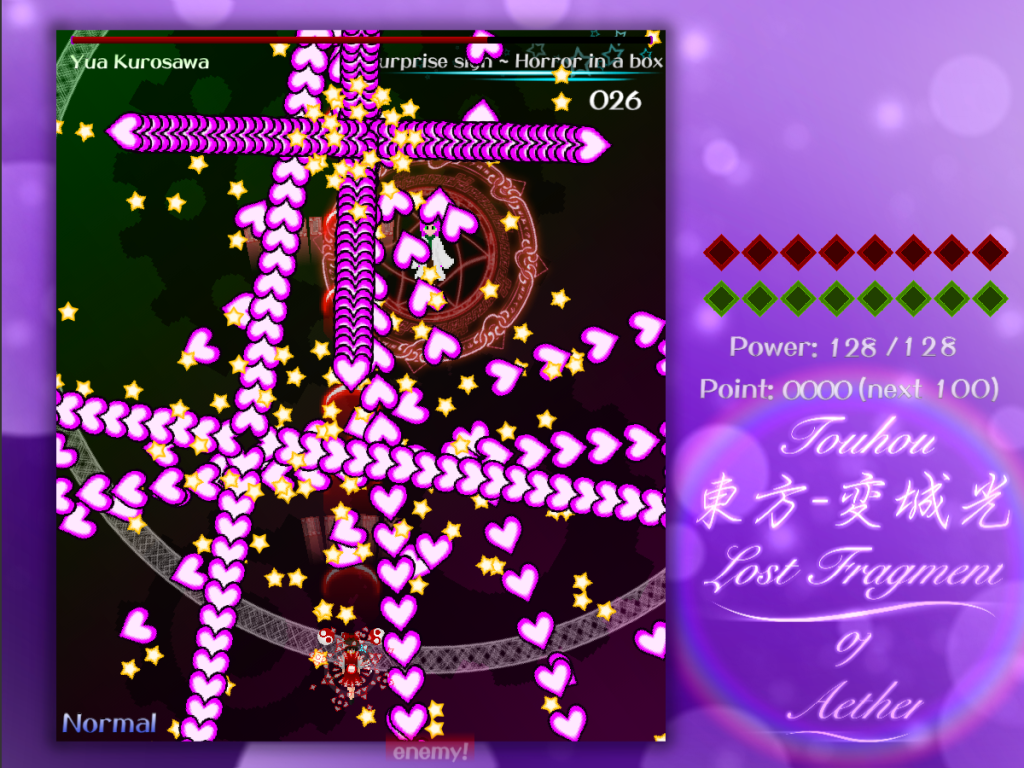
Oh boy, pull up a chair because it’s exactly what you’d expect, unlike other games that would be a digital migraine. It’s your typical vertical shooter where you have to dodge the bullets and defeat the bad guys. As usual, the screen will get cluttered with bullets like you’re staring at a Vegas slot machine in fast-forward. Unfortunately, this game does not have controller support, meaning you’re stuck to your standard arrow keys to move and Z to shoot, which you’ll be holding down until your thumb develops its own pulse.
All of your typical Touhou Project controls are here – you can hold Shift to focus and see your tiny hitbox because you’re navigating through a literal wall of death that isn’t hard enough. When you’re about to get slapped in the face by a stray pixel, you have that X key for a bomb. It clears the screen, and as expected, you only get a few before you’re back to being a sitting duck in a pond made of fire. The game is built in Turbowarp, which is impressive for a browser-based engine, but that doesn’t stop the Lunatic difficulty from being a complete assault on your sanity. What do you do when you’re trying to thread a needle while someone’s throwing buckets of glitter in your eyes?
There’s everything you’d expect in Touhou 6: The Embodiment of Scarlet Devil by having Reimu and Marisa as playable characters. You’ve got four difficulty levels, but as you crank it up, the screen will fill with more danmaku than a 1990s action movie, and the attack patterns will look like a Spirograph going horribly wrong. You have six stages to traverse through, and if you manage to clear it without your brain leaking out of your ears, you will unlock the Extra stage. If you happen to clear that and wait for a true glutton of punishment, the Disaster (or Phantasm) stage opens up for your sanity.
Unlike the official games, there’s no score or grazing. Point items don’t appear until you fill up your power meter. Your goal is to collect life and bomb items to keep your dream alive, but if you’re doing really badly, you can push P to fully restore your lives. Unfortunately, that’s a stand-in for continues, and using it invalidates your one-credit clear and ends the game right after that stage. It’s the game’s way of saying, “Yeah, you finished it but you’re still a loser.” What were they thinking when coming up with unique mechanics?
Graphics
Even after playing the game and suffering a sensory assault from the danmaku, wait until you look at the graphics. Despite things built in Turbowarp and being a browser-based game, some of the graphical choices are like building a functioning Ferrari out of cardboard boxes. And for how the game runs, it’s actually impressive and nothing less than a dog playing a piano.
The art style looks like it’s trying to capture that classic 1990s anime look, but half the time it looks like it was drawn on a napkin during a blackout. The characters look like they wandered out of a bootleg VHS tape you’d find at a flea market for two dollars. The character portraits are still fine, but they don’t resemble anything you’d find in Dragon Ball, Sailor Moon, Evangelion, Pokémon, or any other anime from that decade you could think of. It looks fine, I guess. In terms of backgrounds, you’re flying over lakes, manors, and mountains, but you’ll barely notice them because you’re too busy trying to stay alive and not get killed by danmaku.
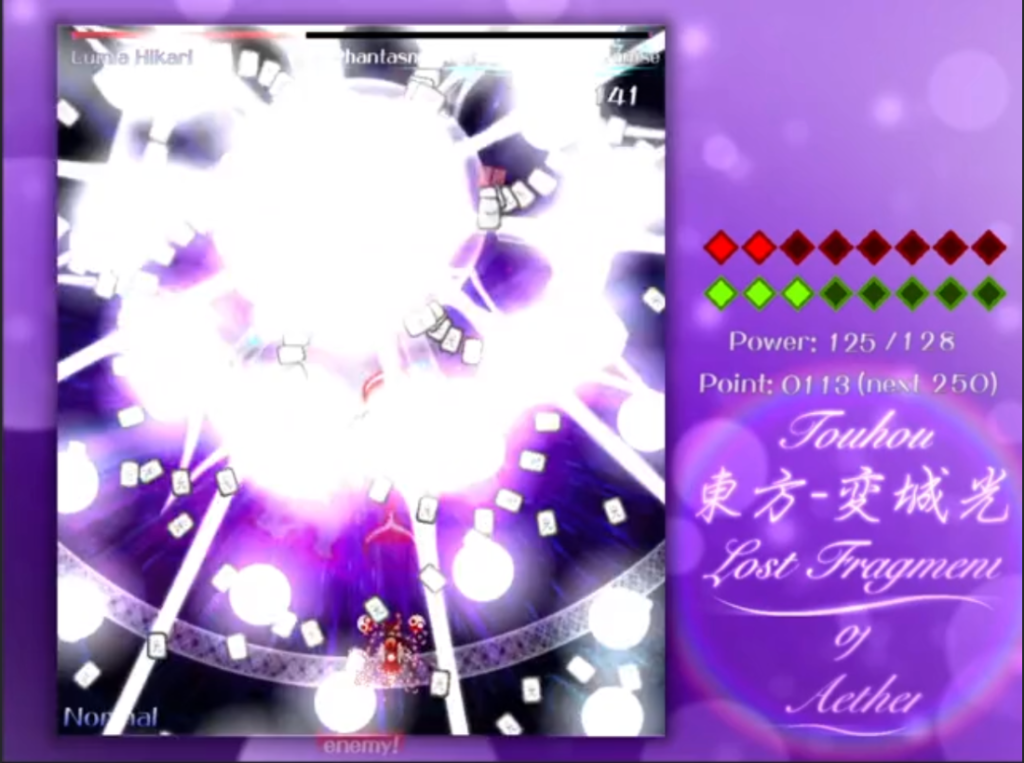
The danmaku is your typical villain, and it depends on how much you value your eyesight. Everything you can think of is present, including glowing orbs, needles, and lasers, like a neon sign factory has exploded in your face. Even when the framerate is starting to chug like a locomotive going uphill from all that danmaku, don’t get me started on some of the stage and boss effects. It will get foggy, making it hard to see the danmaku and your character without squinting like you’re trying to read the fine print on a lease agreement. Every boss has its fair share of attacks, but Lumia Hikari is especially the one where she hurls danmaku in the style of a disco.
Audio
If you haven’t already been blinded by the graphics, prepare your eardrums for something that sounds like a greatest hits album. There are eighteen tracks all composed and/or arranged by Selene. Every stage has its own theme, and they’re all catchy in their own right unlike music that sounds like a MIDI keyboard falling down a flight of stairs. You have the menu theme that serves as the calm before the storm, with the only peace you get before the danmaku begins. A common rule of thumb is every Touhou Project shooter game must start with the Theme of Eastern Story.
Then there’s the stage 1 theme, which signals the call to adventure, while trying not to get killed by the danmaku. The boss theme is where things really start to rev up. The best part about it is you can listen to all of the tracks on YouTube, so when you don’t have the time to play the game just so you can hear that one song, you can just listen to it in your own time. Not all tracks are original though; Shimizu’s theme takes inspiration from the first Len’en game, and the Disaster/Phantasm Stage theme is based on Suika Ibuki’s theme “Broken Moon”. When you hear the terms “inspired” or “based on”, most people will know it will sound like a musical Frankenstein’s monster stitched together from a stack of better games.
To be fair, some tracks inspired by other themes can actually be really good in their own right, but not all songs in the soundtrack are winners. Yua Kurosawa’s theme is short because the character is short. Is this the joke? Do you think listening to a thirty-second loop while at the same time trying to dodge 500 rounds of danmaku is a good idea? That’s not clever detail in my opinion, and having a repetitive track makes me want to pull my hair out.
As with most danmaku fangames, the official Touhou Project sound effects are present, and at least they didn’t try to reimagine them. It’s better than listening to the sound of a blender full of marbles every time you fire a round of danmaku.
Bad Qualities
While it’s impressive that someone made a functional danmaku game in Turbowarp, it’s better than playing a game from a bad Scratch mod. But when the screen gets busy, which is every five seconds, keep an eye on your RAM. If your computer doesn’t have enough RAM to display the danmaku, the framerate will drop faster than a lead balloon, making it difficult to evade a wall of death when the game is moving at the speed of a snail.
Then we have the actual design. Some aspects can be a chore. First off, why does the game only have keyboard support? It was made in 2023, and moving with the cursor keys makes it feel like playing an educational game from 1994. Your fingers will feel like they’re tied in knots after ten minutes. I prefer to play the Touhou Project games with a controller.
The P key is a joke. While intended to restore your lives, it also kills your run. Why even include it? It’s like the game is dangling a carrot in front of you and then slapping you with it. You’d think you’d be able to keep playing but the game treats you like a loser and ends it anyway.
Between the foggy backgrounds and the attack patterns, the former will make it tough to see your character and the danmaku, forcing you to squint so hard that you’re like trying to solve a Sudoku puzzle in the dark.
My Verdict
On one hand, you have a fully functional Touhou Project experience built on a browser engine. That’s like finding out your toaster can also run Doom. It’s impressive, even if your toast will be burned. The music is catchy, and the aesthetic is a nice break from the usual hyper-polished indie stuff.
On the other hand, you have framerate drops that make the game feel like it’s being played on a calculator, a cheat button that treats you like a criminal, and some rough and unapologetic design choices that will make you want to throw your keyboard in a lake. If you’re a diehard Touhou Project fan looking for a challenge, there’s a lot to love here. It’s a labor of love and beautiful, chaotic fun that gives the game a score of 8 out of 10. It’s better than eating rotten pork for sure!
If you’d like to check out the game, I have the link here:
https://selene3.itch.io/touhou-lfoa-pfm-1
Discover more from Drillimation Systems
Subscribe to get the latest posts sent to your email.


Very nice.
LikeLike
You rate it 8/10 yet call it “Not Great,” at what point is it a great game to you???
“Every stage has its own theme, and they’re all catchy in their own right unlike music that sounds like a MIDI keyboard falling down a flight of stairs” is a stupid statement, who reviews a game by saying “oh the music is good unlike music that is bad” ???
For a game that you had just called a “hidden gem” in the review, you sure have a hell of a lot of negativity to say.
LikeLiked by 1 person