

Welcome to a curious little corner of the Touhou Station Jam 2024 where we find Mizuchi Takeover – a game that asks a very bold question: How much do you actually know about girl-in-hat chronology? It’s a low-cost path puzzle game that trades the traditional danmaku carnage for a cerebral, possession-based crawl through the literal history of Gensokyo. While it may look like a minimalist affair and perhaps a bit too quiet for its own good, beneath a teal-heavy GUI lies a mechanical hook that is either a brilliant tribute to a sprawling legacy or a terrifyingly effective exam of game release dates. It is a title that demands your focus, rewards your niche expertise, and reminds us all that sometimes, the most dangerous thing in the danmaku world isn’t a master spark – it’s a lack of fundamental franchise trivia.
Gameplay
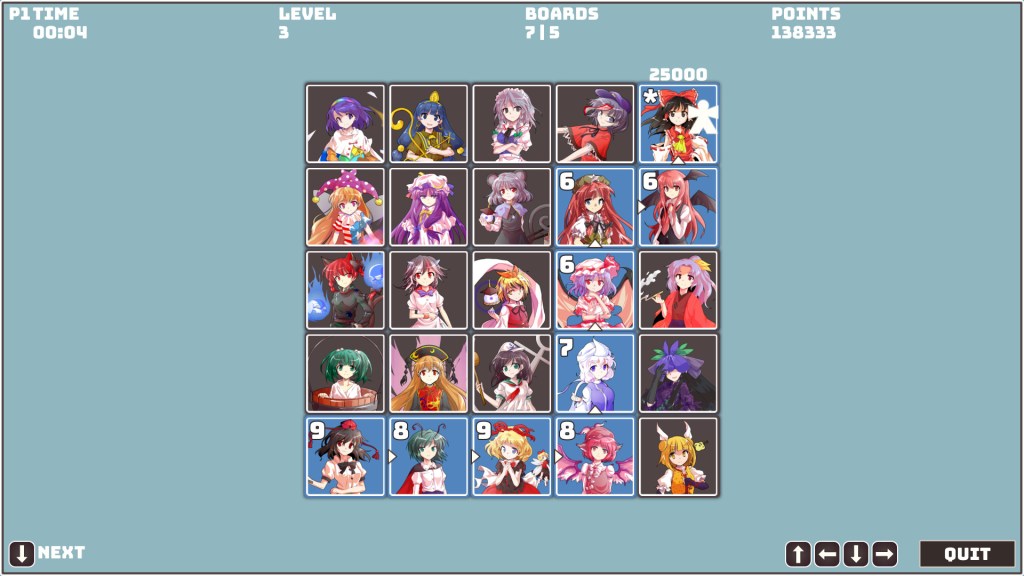
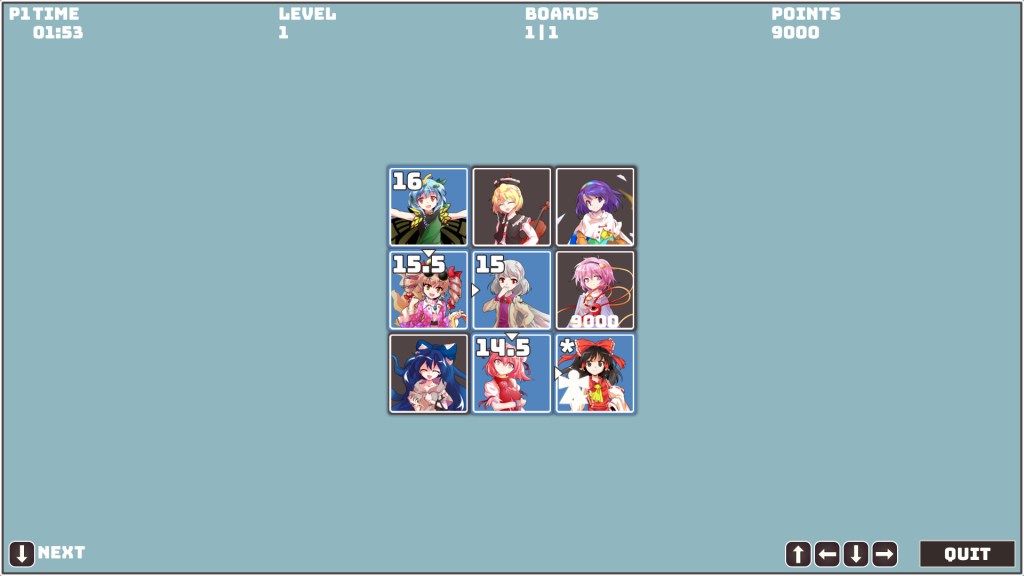
So, how do you play this thing? You’re Mizuchi Miyadeguchi, and your goal is to possess your way through a grid of characters to reach Reimu Hakurei. Sounds simple, right? Not quite – this isn’t your typical Touhou Project danmaku shooter experience. It’s a low-cost path puzzle game where you start in a corner and have to move through adjacent characters, but here’s the kicker: the cost of your move depends on how close the characters are in the series’ release timeline.
If you move from a Touhou 7: Perfect Cherry Blossom character to another character from the same game, that’s a low cost. Moving from that game to Touhou 6: The Embodiment of Scarlet Devil or Touhou 8: Imperishable Night? Still okay. But try to jump from Touhou 6 to Touhou 18: Unconnected Marketeers, and you’re gonna have a bad time. You have to be a literal walking encyclopedia of franchise chronology just to figure out the most efficient route. It’s like taking a history exam while a teal-colored GUI stares back at you. Oh, and guess what you have to do every time you solve a puzzle using the mouse – you have to push the down cursor key just to advance to the next one. Who came up with this?
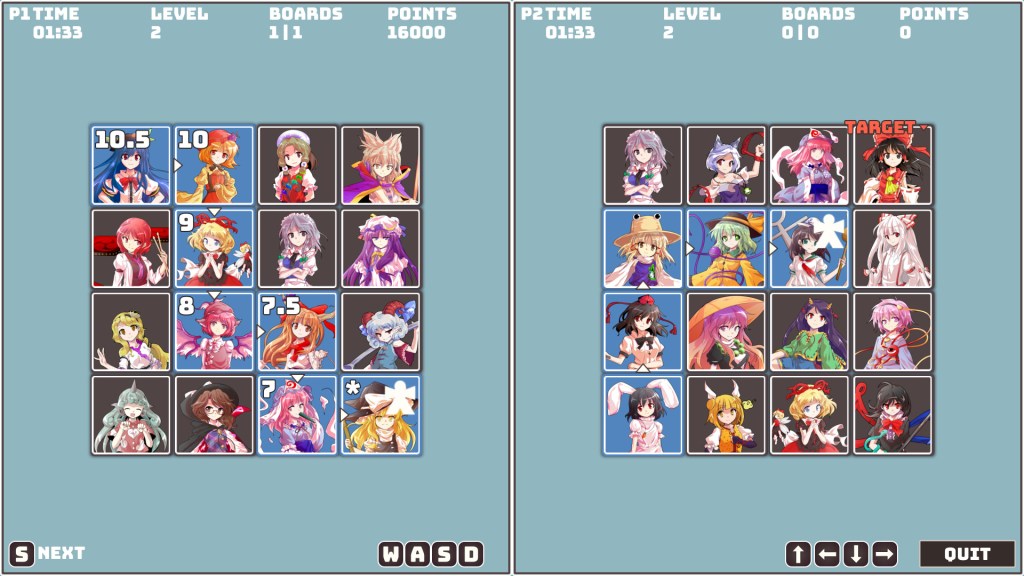
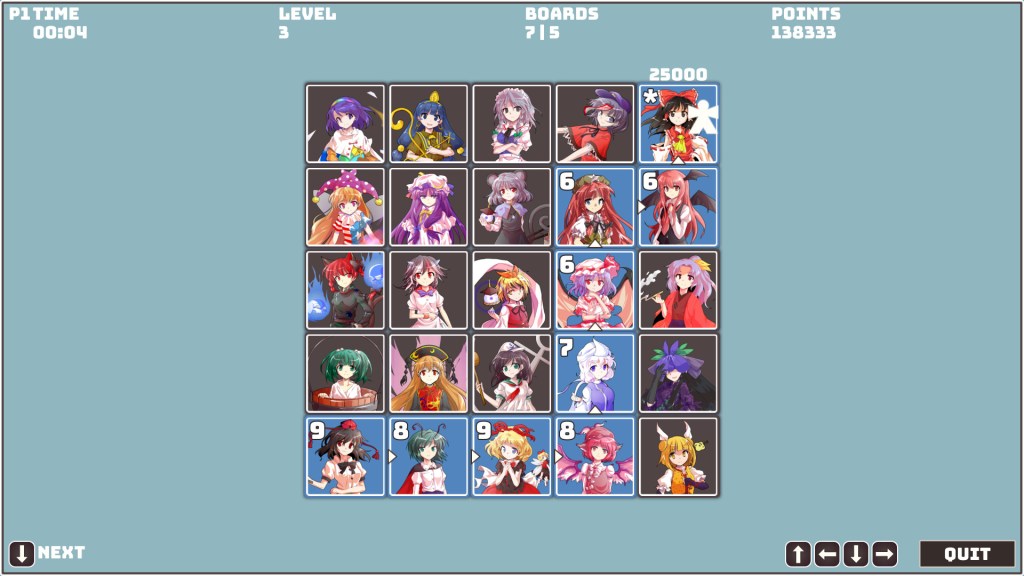
If the base game isn’t giving you enough of a headache, you can toggle the “grow board” option in the setup menu. Every five times you find the perfect path, the board gets bigger. More rows, columns, and opportunities to realize you’ve forgotten which game some obscure midboss first appeared in. There’s even a VS Mode so you can drag a friend into this trivia-fueled challenge to see who knows their knowledge from Touhou 6 to Touhou 18 faster. It’s a test of mental fortitude that will make you wish you were just dodging danmaku instead.
Graphics
What were they thinking with the GUI!? You open the game and you’re slapped in the face by a teal-heavy GUI that looks like it was designed in a dark room by someone who really likes the color of a 1990s toothpaste tube. It’s minimalist, but it’s the kind of minimalism that makes you wonder if the rest of the textures are still stuck in a loading screen somewhere.
And then there’s the character art. Now, the custom art for Mizuchi is actually pretty decent, but the rest of the board is filled with character artworks penned by artist “dairi”. It’s fanart of fanart – like a collage of someone’s favorite browser tabs. But the absolute worst part of this section is the cursor. There is a circling cursor that follows your mouse, and if you move it too fast, it’s like a localized tilt-a-whirl ride on your monitor. It’s not just a puzzle for your brain; it’s a physical endurance test for your inner ear! It’s the kind of visual feature that makes you want to reach into the screen and pin the cursor to the desk with a steak knife.
Audio
I’ve come to the most baffling part of the entire experience: the audio. Or should I say, the lack of music. Touhou Project is a series built on legendary, pulse-pounding soundtracks that people have listened to for decades. But in this game, you get nothing. Total silence except for sound effects. It’s like going to a rock concert and finding out the band decided to perform through the medium of interpretive dance and hushed whispers.
All of the sound effects come from SoundEffect Lab and Ovani. They’re functional, but they’re just there. It’s the gaming equivalent of a plain rice cake. There’s no atmosphere, tension, or any recognizable tunes like “Flowering Night” to get your blood pumping while you’re agonizing over release dates. Playing a Touhou Project game without music feels fundamentally wrong. It’s like watching a silent movie where someone forgot to hire the pianist, and the sound effects make it feel like a pre-television-era cartoon. It turns a cerebral puzzle into a lonely, quiet void where the only thing you can hear is the sound of your own brain cells sizzling.
Other Stuff
If the gameplay and visuals don’t already have you questioning your sanity, let me talk about this game’s source code. It’s available for everyone to see on GitHub, which is great if you want to learn how to program a digital migraine, but it also reveals some interesting development choices. I’m talking about a game that was polished up from a jam build, adding characters from Touhou 19: Unfinished Dream of All Living Ghost and Touhou 20: Fossilized Wonders, which just means there are even more opportunities for you to get the release date math wrong.
There’s also a language toggle now. So, if you want to fail your Touhou Project history exam in a completely different language, the game has you covered. It’s inclusive and global, and still going to make you feel like an idiot when you realize you don’t know the exact chronological gap between a celestial and a hermit. It’s a nice touch for a free indie project, but it doesn’t change the fact that you’re essentially playing a spreadsheet disguised as a possession simulator.
Bad Qualities
And now, I get to the real fun, which is the part that makes me want to eat a raw habanero just to feel a different kind of pain. First, there’s the knowledge barrier. The game doesn’t just want you to be a fan; it wants you to have a PhD in Touhou Project chronology. If you don’t know the exact release order of every single game, you’re not playing a puzzle; you’re playing a guessing game where the prize is a headache.
Then there’s the circling cursor I just mentioned. Who thought this was a good idea? It follows your mouse like a hyperactive fly, and moving too fast is a one-way ticket to dizziness city. It’s a visual choice that feels less like a feature and more like a challenge to your equilibrium.
I can’t forget the complete lack of music. In a franchise where the music is half the draw, playing this in total silence is like eating a sundae made of nothing but plain ice. No fudge, cherry, anything. It’s too quiet and the kind of silence that makes you hear your own heartbeat, which is probably racing because you can’t remember if Touhou 10: Mountain of Faith came before or after Touhou 11: Subterranean Animism.
My Verdict
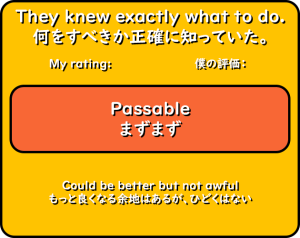
It’s not a bad game by any means, but it’s just a very specific one. On a scale of 10, I give it a 6. If you’re the kind of person who has the Touhou Wiki bookmarked and can recite the release dates of every PC-98 title from memory, you’re going to have a decent time with this. The possession mechanic is a clever way to gamify franchise trivia, and the VS Mode adds a layer of competitive chaos that’s actually pretty fun.
But for everything else, it’s a quiet, teal-colored void that demands a high entry fee of niche knowledge. Between the lack of music and circling cursor that’s currently trying to unscrew my retinas, it’s hard to recommend this to a general audience. It’s a functional, well-coded puzzle game that knows exactly who its audience is. I just wish it didn’t feel so much like I was back in school taking a test I didn’t study for. It’s passable and polished, but it desperately needs a soundtrack and a bottle of Dramamine.
To compare how it would rank on the different parts of the scale:
| Rank | Reason |
|---|---|
| Not Great But Still Good | The core gameplay fits in this category, but the required knowledge of Touhou Project history prevented the game from being placed in this category. |
| Passable | The game is mechanically sound and professionally polished from its original jam build. With a language toggle and a bug-free experience, the lower tiers are avoided. |
| High Contamination | While Mizuchi’s character art is decent, the teal GUI and circling cursor create a genuine physical strain. The cursor movement makes the visuals a test of endurance rather than a joy. |
| Severe Zone | Providing zero music is a massive oversight, stripping away the atmosphere and tension. No Touhou Project fangame is complete without it. |
If you’d like to test your knowledge of Touhou Project history, I have the link here:
https://illusorybread.itch.io/mizuchi-takeover
Discover more from Drillimation Systems
Subscribe to get the latest posts sent to your email.
 Drillimation Systems
This is a sharp, engaging, and cleverly written piece that perfectly captures the unique charm of Mizuchi Takeover. The introduction immediately draws the reader in with its witty tone and intriguing premise, turning what could be a niche concept into something genuinely compelling.
Your description of the gameplay is especially strong—it breaks down a complex, trivia-driven mechanic in a way that feels both accessible and intellectually stimulating. The blend of humor (“terrifyingly effective exam of game release dates”) and insight makes the review feel lively and distinctive.
LikeLike