Japanese is one of the most diverse and complex languages that one can learn. It also comes with a toll. In order to be fluent in the language, learners will need to learn thousands of characters. Around 100 of those characters are reserved for Hiragana and Katakana, while the rest are for kanji, which are the Chinese characters adopted into the language and have at most two or more readings. An educated person will know 2,000 characters. The language also features a number of dialects which can make it challenging to understand, whether spoken or written.
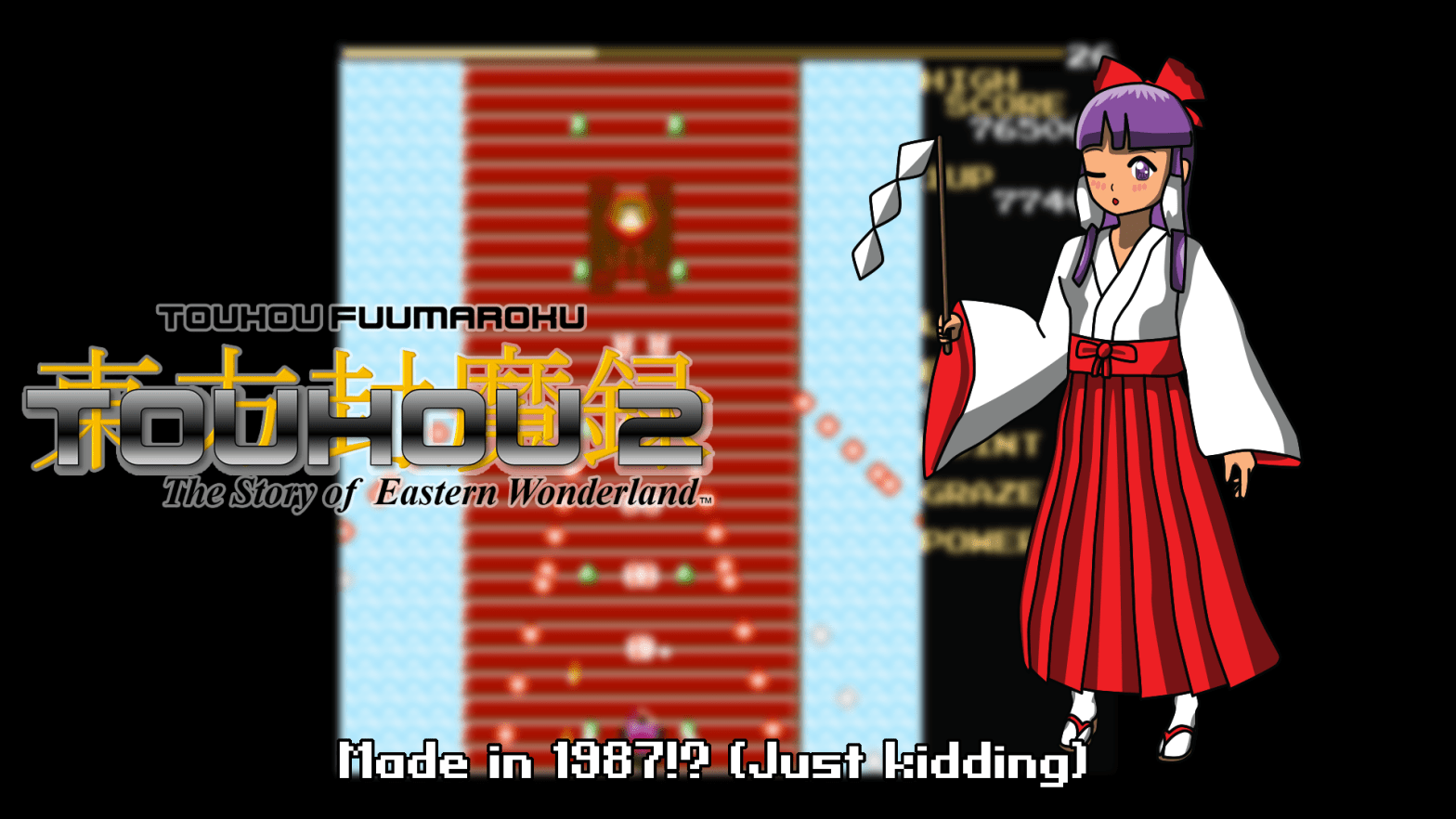
Even writing video game scripts, particularly in Japanese, can be a challenge for a non-native speaker. I will use the second Touhou Project game, The Story of Eastern Wonderland as an example of the words and particles typically used in scriptwriting. Whether you’ve played the original or the NES version, I will sure help explain most of the commonly used particles and words that one might not be familiar with or uncommon. I’m only going to cover the first half of the game to ensure I don’t spoil the story to those who haven’t played the game, though I may do a separate article for the other half of the game in the future.
Words and particles used throughout the game
Word/Particle
Romaji
Translation and usage
わ
wa
Used by females at the end of sentences to indicate admiration or emotion, but can also be used by males for emphasis. All the characters in the game are female, so expect it to crop up often.
じゃん
jan
Contraction of janai (じゃない), a plain negative particle.
んだ
nda
Contraction of noda (のだ), the first character of which can be used for emphasis. The word is also used in the Tohoku dialect to mean “yes”. Its polite counterpart is “nodesu” (のです)
のよ
noyo
The first character is again, used for emphasis, and the second character is not only used for emphasis, but also for certainty purposes and as a vocative particle in literature where the term equates to “O” or “oh”.
なの
nano
Used by females as soft assertion, but also as an intent for a question.
ぅ
u
Used as an extension for pronouncing of words that end in “u” should not be silent or very long. It is often used in desu (です) where the word in full should be pronounced. In standard Japanese, the “u” is silent while the Kansai dialect always has it pronounced.
ありそう
arisou
Probability
し
shi
Sentence ending particle to indicate mild emphasis without explaining a reason.
な
na
Sentence ending particle to indicate mild emphasis
ぞ
zo
Sentence ending particle used by males to indicate certainty or emphasis, but is often used as a warning or threat.
こら
kora
Used to reprimand a person or to call for their actions.
まあ
maa
Has multiple meanings, such as “oh dear”, “come on”, or “well”
いい
ii
Used to mean “good” or “no more”.
あら
ara
Used by women to mean “oh” or “ah”.
もん
mon
Contraction of mono (もの), meaning “thing”.
じゃ
ja
Used to mean “well”.
でしょ
desho
Contraction of “deshou” used by women and is a conjectural form of desu (です) to present a supposition.
ネタ
neta
Often written in katakana, used to mean “reference”
ありゃ
arya
Shortening of aryarya (ありゃりゃ), another term for “oh my”.
ちゃ
cha
Contraction of tewa (ては), used for an undesirable option.
あんた
anta
Contraction and alternate form of anata for informal purposes
かしら
kashira
Particle used by women meaning “I wonder”. Alternative word for the term used by men is kana (かな).
Words and particles used in specific stages
Stage 1
Word/Particle
Romaji
Translation and usage
もしもし
moshi moshi
Used by Genji to confirm that the person being addressed (which in this case is Reimu) is listening.
おいぼれ
oibore
Derogatory term for a senile person.
大人しい
otonashii
In the game, its adverbial form otonashiku is used, and refers to a quiet, gentile or obedient person. The original script had it written in hiragana.
やられる
yarareru
The conjunctive conjugation yararete is used in place, and is used by Rika explaining that she will use her tank to damage the player.
頼む
tanomu
The passive conjugation tanomarete is used in place, and is used as a command for a person to do something.
さらば
saraba
Used for bidding farewell.
しまった
shimatta
Used in response to failure or mistake.
Stage 2
Word/Particle
Romaji
Translation and usage
もらう
morau
Used for either receiving or taking something. In this case, Meira’s planning to steal Reimu’s soul.
いきなり
ikinari
Used by Reimu to ask Meira to suddenly slow down her actions.
どした
doshita
Contraction of doushita, used at the beginning of sentences to explain a reason.
なにそれ
nanisore
Used to question an object, or asking a person what they’re doing.
Stage 3
Word/Particle
Romaji
Translation and usage
きつい
kitsui
Tight, close, or intense.
さあ
saa
Used to mean “come on”, “here”, or “now”
むう
muu
Used to indicate a person mumbling
ほえ
hoe
Stem of hoeru (ほえる), to howl
失礼
shitsurei
Another term for “excuse me” when used as an interjection.
させて
sasete
Conjunctive conjugation of saseru (させる), a causative particle for irregular verbs.
しか
shika
Nothing but [this]
Discover more from Drillimation Systems
Subscribe to get the latest posts sent to your email.
Speaking the words is easy, getting them in the right order is difficult but writing Japanese…. Writing Japanese is beautiful and complex. Like an art form unto itself.

 Drillimation Systems
💯👍😊
LikeLiked by 3 people
Yes indeed, Japanese is most diverse language & culture!
Thank you very much for liking my post on started cycling 🚴♀️🙏🌼
LikeLiked by 2 people
Very interesting!
LikeLiked by 1 person
Respect the effort G
LikeLiked by 1 person
Thanks for liking my post on Neighbour 🙏♥️🌼
LikeLiked by 1 person
Speaking the words is easy, getting them in the right order is difficult but writing Japanese…. Writing Japanese is beautiful and complex. Like an art form unto itself.
LikeLiked by 1 person