
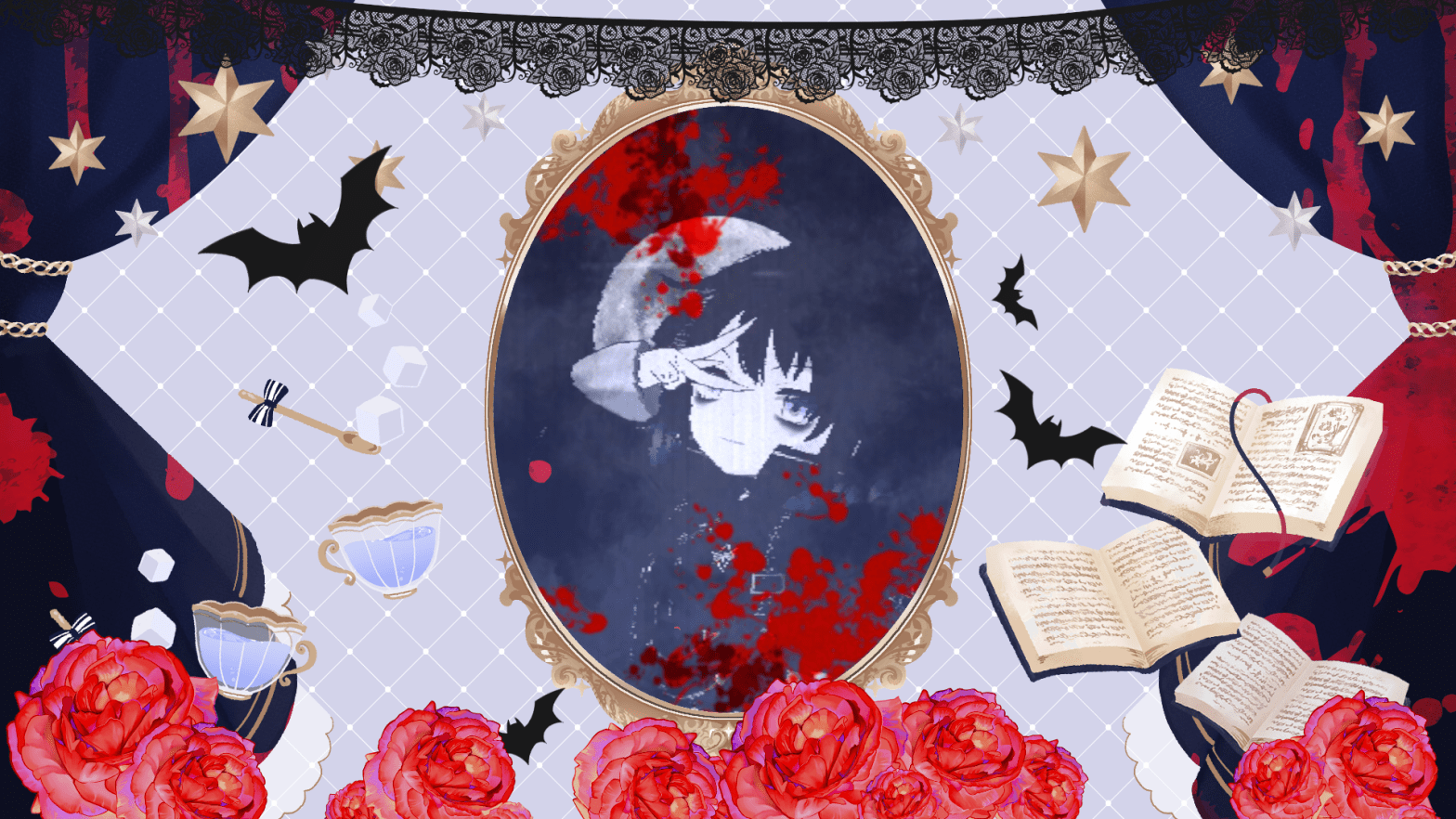
On July 19, 2024, to coincide with the birthday of Japanese musician Kamijo, which Emiko Hosokawa herself self-proclaimed to be a great fan of, Emiko released a teaser for Ophelia Rosenkreuz – her Studio Emiko-produced indie VTuber project and persona. This marks the official launch of her VTuber endeavours, after various failed prototypes involving several different character concepts – from an “Irish magical girl” character to a “heavy metal angel” character.
Designed and modelled by Emiko herself, the VTuber model demonstrates her considerably more advanced VRoid skills compared to that of the Susumu Takajima (or Prophet Driller) – Including beautifully-crafted custom textures (mostly consisting of original textures modified from vanilla VRoid textures, with some textures actually being modifications of existing textures found on BOOTH), experimentation of different facial and bodily proportions, and utilization of Unity in the model creation pipeline (including the usage of techniques such as VTubing software SDKs, emissive textures, and emotes using blend shapes – often in conjunction with said SDKs) – thus making it looking much less like Takajima’s VRoid-based works and more like an actual anime-styled 3D model.
With an appearance that evokes aesthetics of the occult – What actually inspired her to create a design like that, even when she often aligns herself with Catholic thoughts?
The Inspirations Behind Ophelia
Ophelia Rosenkreuz as a character is inspired by two things: Emiko’s renewed interest in vampires and her newfound interest in the Japanese visual kei scene of the 80s-2000s.
Her interest in vampires might well predate her partnership with Drillimation Systems – presumably as far back as 2018, when she discovered a copy of the original novel version of Dracula in her school library. During that time, she was conceptualizing on what would become an unreleased prototype for the Helligbard series, incorporating the fanon perception that Grimsley from Pokémon Black and White is actually a vampire. This, however, lasted only for roughly two years before she nearly refrained from mentioning topics about such beings during the pandemic. In spite of the pandemic putting a halt on this folkloric interest, she said that an encounter with the hugely popular manga series The Case Study of Vanitas (otherwise known as Vanitas no Carte), as well as a cover version of Powerwolf’s We Drink Your Blood, renewed this interest of hers.
In regards to visual kei, she is a latecomer to this scene, yet she is quick to be assimilated to it. According to what she claims, Hosokawa stated that at the beginning of her summer break, while she was listening to some songs by the Japanese metal act Galneryus, recommendations for Jupiter, another J-metal act, popped up. This particular group led her to many more acts in the visual kei scene such as (in chronological order) Versailles, Kamijo (being both a solo artist and a member of Versailles), Malice Mizer, Moi dix Mois, and Buck-Tick. In her commentaries on Ophelia’s design, she stated that the character was designed in a way that meant to be a homage to Mana (of Malice Mizer and Moi dix Mois fame; through her thorough use of black and blue in the character’s color scheme) and Kamijo (through the fact that Ophelia is a vampire and (to a lesser extent) the minor Baroque / Rococo-inspired motifs in her outfit).
Ophelia’s lore was written by Hosokawa herself, with almost no assistance from other people. The lore feels like as if it comes out of an actual fantasy novel – And while most of Ophelia’s lore is original, there’s one detail that isn’t originally hers: With permission to adapt and retcon (i.e. removing all details pertaining to Touhou Project and using the content as fully standalone content) from FanTouhouMusic, she incorporated Alan Lawrence, a character from the alternate fifth stage of Emergence of Crimson Acropolis, into Ophelia’s lore. In it, she confirmed that Alan is a demonic sorcerer, and that after Ophelia was transformed into a vampire, he enslaved her, making her a henchman and apprentice of his. She was a wicked individual cooperating with him for a long time, until one day she realized the horrible truth about his acts and offered to betray him for the side of the good. Also, per the lore, Ophelia’s main goal is to destroy him and ending the miseries of many who had become his victims.
Hosokawa stated that the reason why she can actually write sweeping fantasy epic-inspired lore like that is partially due to the fact she is an avid reader of fantasy stories since childhood. Having read Gothic fiction classics such as Dracula and Frankenstein, as well as being a fan of the international UK-based heavy metal act Gloryhammer (notable for their concept albums revolving around a science-fantasy saga), she often cited these two sources as her major inspirations for her lorewriting.
What else is she thinking about?
As Hosokawa said earlier, due to Ophelia’s design incorporating symbolism often pertaining to the occult such as hexagrams, some people might raise questions about Hosokawa’s sanity and faith while designing the character. They might be either mild censures such as calling her “God-blessed naughty artist”, or in the worst cases, labelling the VTuber as “part of a Satanic agenda”, amongst accusations of Hosokawa being secretly a Satanist by these people. In spite of these possible accusations, however, Hosokawa have stated that the design was meant to taken as tongue-in-cheek, and by depicting a character with that kind of character design as protagonistic, she didn’t intend on promoting / defending occult and Satanic beliefs.
Likewise, the much darker thematic material which inspires Ophelia’s own concept has solidified Hosokawa’s intentions of making a VTuber whose content is tailored towards teens – a stark difference from her previous unused character concepts, which can be potentially misleading due to their much lighter-hearted concepts.
Afterword
Hosokawa’s love for two particular cultural aspects has influenced her conceptualization of Ophelia – and even from the design alone, people can see the extent of the influence of these aspects on said character’s design. Despite the design might bear occult connotations and might attract accusations from conservative VTuber fans, Hosokawa emphasized that there is no occult propaganda agenda with this VTuber persona as the design isn’t meant to be taken seriously, and everything is done purely for her enthusiasm towards a subculture relatively unknown to many Westerners since the 2000s.
Discover more from Drillimation Systems
Subscribe to get the latest posts sent to your email.
 Drillimation Systems
2 thoughts on “Studio Emiko Launches Ophelia Rosenkreuz VTuber Project, Details Inspirations and Lore”