
DISCLAIMER: This article is for educational purposes only. I do not support or endorse piracy of the film for any reason whatsoever.
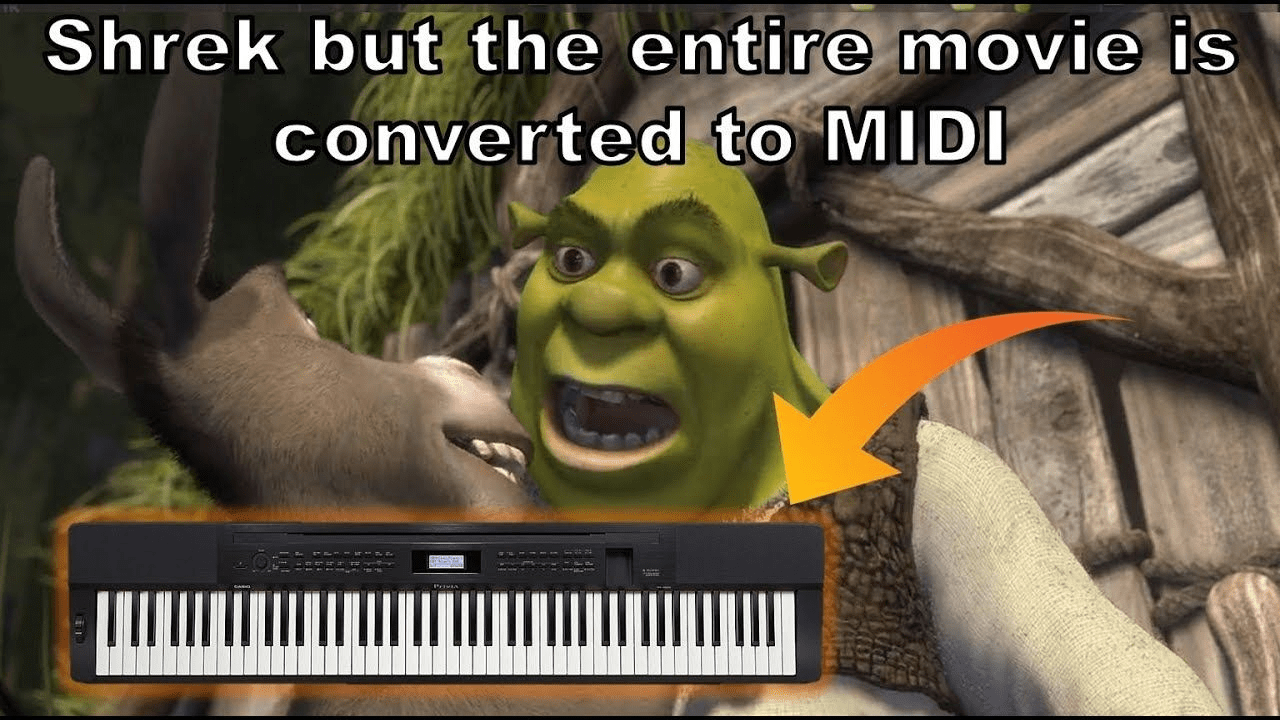
The recent death of the lead singer for Smash Mouth, Steve Harwell, sent shockwaves across the Internet, including the Shrek fandom. But I will not be talking about that. I’m diving into a different topic. If you were wanting to watch the first Shrek film sometime between 2018 and 2022, but you simply didn’t want to pay, you might have stumbled across this on YouTube.
What I’m saying is the Shrek MIDI File. At the time, it may have been a way to familiarize yourself with the Shrek franchise, but all the audio had been converted and piped through a piano. It would’ve been a funny way to experience the film. All you had to do was hop on YouTube, search “Shrek MIDI”, and bam. You had a pianified version of the full version of the first Shrek film right in your hands. One day, it simply vanished from YouTube. What actually happened? How was this even possible?
Background
On May 18, 2001, after being stuck in development hell for a decade, the first Shrek film was released in theatres in the United States. You couldn’t take it home to watch on your VCR or DVD player until November 2, 2001 – nearly six months after it opened. This was the theatrical exclusivity window at the time, and after all, studios only make the majority of revenue when a film is in theatres but have the opportunity to continue making money after a film leaves the theatre. The film was a smash hit becoming the summer blockbuster of that year and was the first winner for the Academy Award for Best Animated Feature at the 2002 Oscars. It marked the beginning of a popular new franchise.
When YouTube first launched, users were limited to videos that were ten minutes in length. This was to ensure their servers did not get overwhelmed. Advancements in technology made that limitation obsolete. Users were free to upload their own independent short films or the even rarer full-length motion pictures.
How is it possible to convert an entire motion picture to MIDI!?
The interesting thing about the Shrek MIDI file wasn’t another YouTuber’s own adaptation of the film, but it was the complete actual film with the audio run through MIDI. Many people, including myself, are questioning on how this was even possible.
A number of digital audio workstations (DAW) have the ability to convert audio to a MIDI sequence. Converting audio to MIDI can be useful for things like transcribing live performances or recordings, creating a MIDI version of a song to use as a head start for a cover, extracting specific instruments from a recording, or using it to learn how a particular song was played.
MIDI conversion, however, isn’t perfect, and it has its fair share of limitations. First of all, accurately identifying the tuning or pitch of instruments such as an electric guitar or saxophone is difficult. Second identifying the timing of notes is also challenging too, especially if a recording has a lot of background noise. Also not to mention accurately capturing certain nuances such as vibrato and pitch slides.
With the arrival of Blu-ray in the mid-2000s, computers had gained the ability to play DVD movies, and digital storefronts such as iTunes made it possible to buy or rent movies digitally. YouTube also arrived at the same time. Because of the ten-minute limit at the time, it was extremely trivial to copy the whole film and tear down the paywall.
As of today, Most theatrically-released films have been released on Blu-ray, iTunes, and streaming services. Many studios have included within Blu-ray copies of their films a single-use alphanumeric code that the consumer can use to legally download a digital copy of that film onto their computer. However, that digital copy will have some form of DRM to deter the consumer from making illegal copies of the film outside the purposes of Fair Use.
Moving forward, how are people converting entire motion pictures into MIDI format? Well, one way would be to extract the film’s audio track and run it through a converter. It would be very difficult to do since most films nowadays are 1.5 – 3 hours long. That length also means a large file size. Even with a runtime of 90 minutes at 24fps and under the MP4 format, the file size would be 56GB at 1080p. That’s way too large. How about 720p? Still too large at 34.5GB.
Taking iTunes into consideration, the average file size for one film spanning two hours is much smaller than above and would be about 2GB, with one hour being equivalent to one gigabyte. If you only extract the audio, that number would go down to one gigabyte. That would be good enough to convert. If you try do convert online, this is where things get a little tricky. Most conversion services don’t allow more than a gigabyte of content since it would be overwhelming. Some would find it easier to use an actual program to do the job instead of online.
Your converted MIDI file is still the entire film, but it sounds like a piano being banged on by a little kid. It’s funny how Shrek‘s first adventure could be experienced by movie fans wanting to experience a film in a new way. People simply not wanting to pay for the film would flock to this instead.
A MIDI conversion of a motion picture is not Fair Use
Obviously, copying an entire motion picture and uploading it to YouTube is just outright illegal. And no, you cannot shield yourself from liability by claiming Fair Use on this. Even though you transformed the film in a humorous way, motion pictures are unquestionably the most creative types of works worthy of copyright protection, the entirety of the film is used, and this transformation creates a competing substitute for the original. The Shrek MIDI file remained on YouTube for four years, until DreamWorks’ legal team decided to do something about this.
This is not the first time the Shrek MIDI file had been taken off YouTube. The original video, which had the film overlaid on top of Synthesia gameplay, ended up tripping YouTube’s Content ID system, not only resulting in a claim being applied, but a copyright strike as well. Even if reuploaded with effects that make it feel like Giygas from Earthbound cursed it, their lawyers were not very happy about this, especially given the fact the film would be listed high in YouTube search results. There was also one point where if you searched terms such as “converted to MIDI” or “Shrek MIDI” on Google, the Shrek MIDI file would appear at the top of the list, even above the actual Shrek film that you could also purchase on YouTube.
The original uploader made multiple videos on the topic, including playing the Shrek MIDI file on an actual piano through an iPad. This angered DreamWorks’ lawyers even more, and heightened the chance of the uploader not only getting their YouTube account terminated, but also a lawsuit at their doorstep.
After all this drama, the Shrek MIDI file alongside the uploader’s channel were both taken down. Some people attempted to copy what the Shrek MIDI file did by trying other films, and succeeded in some degree. It may be up to the studios to try and get those off YouTube. That’s the story of the Shrek MIDI file.
Sources
- https://phantom-sounds.com/en-us/blogs/blog/how-to-convert-audio-to-midi
- https://www.viwizard.com/drm-basics/itunes-movies-sd-vs-hd.html
- https://en.wikipedia.org/wiki/Digital_copy
Discover more from Drillimation Systems
Subscribe to get the latest posts sent to your email.
 Drillimation Systems